The Lilac People: A Novel
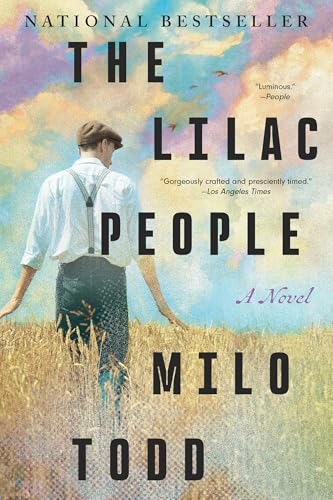
2026 LAMBDA LITERARY AWARD WINNER
Finalist for the New England Book Award
"Reminiscent of Anthony Doerr's All the Light We Cannot See . . . Heart-stopping in its suspense and dramatic reveals." —The Boston Globe
A moving and deeply humane story about a trans man who must relinquish the freedoms of prewar Berlin to survive first the Nazis then the Allies, all while protecting the ones he loves
In 1932 Berlin, a trans man named Bertie and his friends spend carefree nights at the Eldorado Club, the epicenter of Berlin’s thriving queer community. An employee of the renowned Dr. Magnus Hirschfeld at the Institute of Sexual Science, Bertie works to improve queer rights in Germany and beyond. But everything changes when Hitler rises to power. The Institute is raided, the Eldorado is shuttered, and queer people are rounded up. Bertie barely escapes with his girlfriend, Sofie, to a nearby farm. There they take on the identities of an elderly couple and live for more than a decade in isolation.
In the final days of the war, with their freedom in sight, Bertie and Sofie find a young trans man collapsed on their property, still dressed in Holocaust prison clothes. They vow to protect him—not from the Nazis, but from the Allied forces who are arresting queer prisoners while liberating the rest of the country. Ironically, as the Allies’ vise grip closes on Bertie and his family, their only salvation is to flee to the United States.
Brimming with hope, resilience, and the enduring power of community, The Lilac People tells an extraordinary story inspired by real events and recovers an unknown moment of World War II and trans history.
BUY THE BOOK
Join a book club that is reading The Lilac People: A Novel!
Community Reviews

The social historian James Loewen believes that history does not move in a straight line towards a more tolerant society. For example, in terms of the history of tolerance of same-sex relationships, Loewen believes that American society was more tolerant of same-sex relationships in the 1850s than in the 1920s (Cunningham 2018). In terms of LGBTQ+ rights, Germany, between the world wars, urban Germany went from being more tolerant during the time of Weimar Germany to becoming very dangerous for LGBTQ+ people under Nazi Germany. Sadly, during the American occupation of post-World War II Germany, trans and gay people were imprisoned. Writer Milo Todd writes that during the American occupation of post-World War II Germany, the American officials chose “the harsher Nazi law instead of what had been on the books for generations before them. They were choosing the Nazi law when they had chosen not to honor all those against other peoples” (Todd 228). Loewen’s idea that tolerance does not follow a straight line in history is a theme in Milo Todd’s novel The Lilac People. The German song, “Das Lila Lied” (The Lilac Song), was written by Kurt Schwabach and Mischa Spoliansky in 1920 in honor of the German sexologist Magnus Hirschfeld. Milo Todd writes that “Das Lila Lied” “is the first known documented queer anthem in the colonized world” (Todd 2025 299). Todd based the main story of their novel on three “trans masculine and/or intersex individuals documented to have survived World War II: Berthold Buttgereit, Karl M. Baer, and Gerd Katter” (Todd 2025 294). I have the book on my Kindle. The Lilac People is a moving novel.
Works Cited:
Cunningham, Lillian. “Episode 15 - James Buchanan | PRESIDENTIAL podcast | The Washington Post.” Washington Post Podcasts. YouTube, 37:43 minutes. May 8, 2018. Episode 15 - James Buchanan | PRESIDENTIAL podcast | The Washington Post
Todd, Milo. 2025. ““Das Lila Lied” (“The Lilac Song).” In The Lilac People. Berkeley, California: Counterpoint Press California. Pages 299-300. Kindle.
Todd, Milo. 2025. ““Notes from the Author.” In The Lilac People. Berkeley, California: Counterpoint Press California. Pages 291-298. Kindle.
The Lilac People is a powerful, haunting novel based on real events, offering a fictionalized account of the persecution of the LGBTQ community during the rise of the Nazi regime in 1930s Germany. After roughly fifteen years of unprecedented freedom—following centuries of oppression—the community once again finds itself in grave danger as fascism tightens its grip.
At the heart of the story is Bertie, a trans man working at Berlin’s famed Institute of Sexual Science under Dr. Magnus Hirschfeld, a pioneering sexologist and advocate. When he isn’t assisting at the Institute, Bertie spends his nights at the Eldorado Club—dancing, drinking, and commiserating with friends in a space where the LGBTQ community can finally breathe. But as the Nazis gain power, those safe spaces dissolve, and the people who once lived openly and vibrantly become direct targets of hatred and violence.
Though the author adjusts the real-world timeline, the narrative centers on Bertie and his girlfriend Sofie as they flee following a brutal attack on the Institute during the Night of the Long Knives. The chaos and terror of that event—during which as many as a thousand were murdered and many more arrested or sent to Dachau—is vividly rendered. The pair take refuge on a rural farm, eventually adopting the identities of its former residents in a desperate bid for survival.
The novel also confronts a lesser-known and devastating truth: liberation from the concentration camps did not bring freedom for everyone. American forces, too, sought out and arrested gay and trans individuals, continuing the persecution long after the camps were liberated. It is a sobering reminder of how deeply rooted these injustices are—and how shamefully they were perpetuated by even the liberators.
Todd writes with empathy and nuance, crafting characters who feel real, vulnerable, and deeply human. Through Bertie, Sofie, and later Karl, readers gain a clearer understanding of the pain, fear, resilience, and hope experienced by many in the LGBTQ community during this era.
I found The Lilac People both enlightening and emotionally gripping. It illuminated a part of Nazi history I had not previously known, and it left me reflecting on humanity’s capacity for cruelty—and our responsibility to do better. The story lingers long after the final page, leaving me hopeful that we can still pull ourselves out of the moral tailspin we so often seem caught in, even as I worry about whether we will.
So this storyline was fascinating to learn more about this movement in pre Nazi Germany. Sadly at times it read like it could also be the near distant future in the US. Although I appreciated the subject, unfortunately the writing didn’t do it for me. And anachronistic things in historical fiction really get under my skin — the book describes Bert and Sofie fleeing Berlin in an automobile, but at that time only the very elite had personal automobiles in Germany, and the likelihood of them having one AND Gert to follow behind just doesn’t make sense. The other one was talking about smoking cigarettes and something about the filter. Cigarette didn’t have filters generally until the 1950s. I know these are minor things but it affects my judgment of historical fiction. I like it to be true to period. And these things could have been easily been written out differently.
See why thousands of readers are using Bookclubs to stay connected.