Starry Messenger: Cosmic Perspectives on Civilization
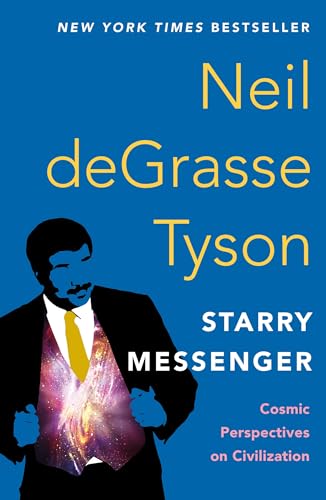
THE NEW YORK TIMES BESTSELLER
2023 USIA AWARD FOR ASTROPHYSICS
“Every page is lit up by an original poetic imagination but bearing the unmistakable stamp of a rational mind, steeped in maths and science.”—Richard Dawkins, author of The Selfish Gene and The God Delusion
Bringing his cosmic perspective to civilization on Earth, Neil deGrasse Tyson shines new light on the crucial fault lines of our time—war, politics, religion, truth, beauty, gender, and race—in a way that stimulates a deeper sense of unity for us all.
In a time when our political and cultural views feel more polarized than ever, Tyson provides a much-needed antidote to so much of what divides us, while making a passionate case for the twin chariots of enlightenment—a cosmic perspective and the rationality of science.
After thinking deeply about how science sees the world and about Earth as a planet, the human brain has the capacity to reset and recalibrates life’s priorities, shaping the actions we might take in response. No outlook on culture, society, or civilization remains untouched.
With crystalline prose, Starry Messenger walks us through the scientific palette that sees and paints the world differently. From insights on resolving global conflict to reminders of how precious it is to be alive, Tyson reveals, with warmth and eloquence, an array of brilliant and beautiful truths that apply to us all, informed and enlightened by knowledge of our place in the universe.
BUY THE BOOK
Community Reviews

Contrary to the title's promise of cosmic perspectives on civilization, the book offers a heavily biased and superficial view of contemporary themes. While I respect differing opinions, the title's misleading nature left me regretting my purchase.
The book starts well by highlighting humanity's cosmic perspective following the moon landing and subsequent changes. However, it quickly loses its appeal.
My primary issue with the book is its shallow treatment of complex issues, such as the Israel-Palestine conflict, gender, race, and more. Tyson's arguments often lack depth and rely on quirky anecdotes rather than substantive reasoning. For instance, he reduces the Israel-Palestine conflict to a few sentences, oversimplifying one of the world's most enduring disputes.
Tyson's take on gender, comparing it to the spectrum of a rainbow and Santa's reindeer (Santa’s reindeers did not lose their antlers and thus were female so Rudolf was misgendered), dismisses biology and oversimplifies a nuanced topic. His approach to race and skin color, advocating for color codes akin to makeup shades, fails to acknowledge the complexities of racial identity.
Furthermore, Tyson's book suggests that vegans should feel like plant killers, using a sci-fi argument to support his stance. He also reiterates that Africa is the cradle of humanity, which is not entirely accurate.
The book's tone is condescending, and Tyson repeatedly references his own tweets, defending them at length.
For example,
“Last anybody checked, Egypt is in Africa. The civilization was so advanced that denial among White people runs deep,42 including the storyline of Stargate, a 1994 sci-fi film in which the Great Pyramids were conceived and designed not by Africans, but by godlike humanoid aliens who subjugated the human Egyptians.”
Overall, "Starry Messenger" comes across as a shallow exploration of important subjects, lacking in depth and opposing viewpoints, and often relying on fictional data to support its arguments.


See why thousands of readers are using Bookclubs to stay connected.