King of Kings: The Iranian Revolution: A Story of Hubris, Delusion and Catastrophic Miscalculation
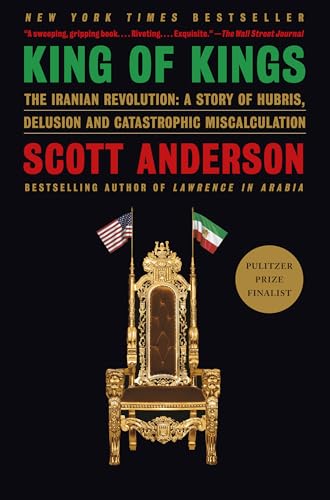
PULITZER PRIZE FINALIST • A NEW YORK TIMES NOTABLE BOOK • NEW YORK TIMES BESTSELLER • FINALIST FOR THE NATIONAL BOOK CRITICS CIRCLE AWARD FOR NONFICTION • KIRKUS PRIZE WINNER • From the author of the landmark bestseller Lawrence in Arabia comes a stunningly revelatory narrative history of the Iranian Revolution, one of the most momentous events in modern times. This groundbreaking work exposes the jaw-dropping stupidity of the American government and traces the rise of religious nationalism, offering essential insights into today's global unrest.
“A masterful and propulsive account that chronicles a devastatingly transformative series of events whose aftereffects reverberate to this day.” —The Kirkus Prize 2025 Jury
“An exceptional and important book. Scrupulous and enterprising reporting rarely combine with such superb storytelling.” —The New York Times Book Review
“A masterful and gripping account. Anderson gives us a page-turning history lesson that is more relevant than ever.” —Rajiv Chandrasekaran, author Imperial Life in the Emerald City, a finalist for the National Book Award
On New Year’s Eve, 1977, on a state visit to Iran, President Jimmy Carter toasted Shah Mohammad Reza Pahlavi, King of Kings, Light of the Aryans, Shadow of God on Earth, praising Iran as “an island of stability “ due to “your leadership and the respect and admiration and love which your people give to you.” Iran had the world’s fifth largest army and was awash in billions of dollars in oil revenues. Construction cranes dotted the skyline of its booming capital, Tehran. The regime’s feared secret police force SAVAK had crushed communist opposition, and the Shah had bought off the conservative Muslim clergy inside the country. He seemed invulnerable, and invaluable to the United States as an ally in the Cold War. Fourteen months later the Shah fled Iran into exile, forced from the throne by a volcanic religious revolution led by a fiery cleric named Ayatollah Khomeini. The ensuing hostage crisis forever damaged America’s standing in the world. How could the United States, which had one of the largest CIA stations in the world and thousands of military personnel in Iran, have been so blind?
The spellbinding story Scott Anderson weaves is one of a dictator blind to the disdain of his subjects and a superpower blundering into disaster. Scott Anderson tells this astonishing tale with the narrative brio, mordant wit, and keen analysis that made his bestselling Lawrence of Arabia one of the key texts in understanding the modern Middle East. The Iranian Revolution, Anderson convincingly argues, was as world-shattering an event as the French and Russian revolutions. In the Middle East, in India, in Southeast Asia, in Europe, and now in the United States, the hatred of economically-marginalized, religiously-fervent masses for a wealthy secular elite has led to violence and upheaval – and Iran was the template. King of Kings is a bravura work of history, and a warning.
BUY THE BOOK
Community Reviews
Relevant book during the Iran war. It's about the Shah not current Islamic regime yet we see how they gained power and took control.
The Shah was never a hard dictator. More like a paranoic loser with endless power. And unfortunately for him the US president was the very progressive Carter. Meaning both sides showed extreme weakness. Once the protests started and he didn't beat them down or stop them his power was declining and soon gone. Iranian leadership told USA to save them. Put in 10K military men and save the regime. USA said they would only help not do 100% of the work. Iranians were confused. They couldn't do anything, the regime was weak and poor. The army was larger than all Middle East armies combined yet this didn't help against protestors. And it also meant the nation didn't have money left to take care of internal issues. Obviously people were angry and unfortunately they replaced the bad regime with a horrible regime.
The Shah lived a lavish life with huge parties. Both Islamists and socialists were angry. And I guess Carter never really fully supported pro Western regimes. He was always after a left-wing revolution and it bit USA in the butt. As Iranian students took embassy workers hostage and Carter couldn't free them it meant he lost the reelection. Overall showing military weakness right when USA demanding more focus and strength from the president. He failed. Meanwhile Shah was dying of cancer and incompetent too. The Western world was slowly collapsing in the 1970's. Both Islamists and socialists gained power. And violence and death was resurrecting.
The Shah was never a hard dictator. More like a paranoic loser with endless power. And unfortunately for him the US president was the very progressive Carter. Meaning both sides showed extreme weakness. Once the protests started and he didn't beat them down or stop them his power was declining and soon gone. Iranian leadership told USA to save them. Put in 10K military men and save the regime. USA said they would only help not do 100% of the work. Iranians were confused. They couldn't do anything, the regime was weak and poor. The army was larger than all Middle East armies combined yet this didn't help against protestors. And it also meant the nation didn't have money left to take care of internal issues. Obviously people were angry and unfortunately they replaced the bad regime with a horrible regime.
The Shah lived a lavish life with huge parties. Both Islamists and socialists were angry. And I guess Carter never really fully supported pro Western regimes. He was always after a left-wing revolution and it bit USA in the butt. As Iranian students took embassy workers hostage and Carter couldn't free them it meant he lost the reelection. Overall showing military weakness right when USA demanding more focus and strength from the president. He failed. Meanwhile Shah was dying of cancer and incompetent too. The Western world was slowly collapsing in the 1970's. Both Islamists and socialists gained power. And violence and death was resurrecting.

Scott Anderson’s King of Kings is informative and well-researched, but lacks a coherent narrative.
The book covered the entire historical scope of the Iranian Revolution. It also made a great effort not to whitewash the Shah or Ruhollah Khomeini. Both were awful people who did awful things. The book also covered Shia Islam’s influence on the Iranian Revolution. The American political influence was also covered. Because the book tackled so many different factors from so many different perspectives, it was overly long and overwhelming.
Maybe Scott Anderson’s writing style just wasn’t for me. He seemed to repeat himself a lot. I much preferred the writing style of Patrick Radden Keefe’s Say Nothing (2018). That felt more engaging and focused. I also think that Scott Anderson has a disadvantage as he was writing from a Western perspective for a Western audience. I much preferred For the Sun After Long Nights by Fatemeh Jamalpour and Nilo Tabrizy (2025). It was actually by Iranian women. It was a shorter book too.
I would still recommend this book to anyone interested in the topic. Iran has a fascinating history and culture.
The book covered the entire historical scope of the Iranian Revolution. It also made a great effort not to whitewash the Shah or Ruhollah Khomeini. Both were awful people who did awful things. The book also covered Shia Islam’s influence on the Iranian Revolution. The American political influence was also covered. Because the book tackled so many different factors from so many different perspectives, it was overly long and overwhelming.
Maybe Scott Anderson’s writing style just wasn’t for me. He seemed to repeat himself a lot. I much preferred the writing style of Patrick Radden Keefe’s Say Nothing (2018). That felt more engaging and focused. I also think that Scott Anderson has a disadvantage as he was writing from a Western perspective for a Western audience. I much preferred For the Sun After Long Nights by Fatemeh Jamalpour and Nilo Tabrizy (2025). It was actually by Iranian women. It was a shorter book too.
I would still recommend this book to anyone interested in the topic. Iran has a fascinating history and culture.
An impressive book, on an important subject. I knew that I was woefully underinformed about the particulars of the Iranian revolution, and this book seriously filled in the gaps. Anderson’s writing is both clear and compelling, which is exactly what this needed. By the time I finished, I was surprised just how deep and broad the analysis had been. I had absorbed so much about the details of life in Iran under the Shah, as well as the American presence there, without the reading ever feeling dry or overly dense.
The book is kind of a hybrid between political history and morality tale. The events detailed are complex and contextualized, arising from specific actions, missteps, and confluences of fate. But underlying it all is a kind of drumbeat, calling to mind again and again the hubris at work. You can’t help but marvel at the blinding arrogance of both the Iranian governing elite and the American intelligence apparatus. Their critical disconnect from the facts on the ground, coupled with an exaggerated sense of their own capacity, could only lead to disastrous results. In Anderson’s hands, this trail of inevitability makes a coherent, compelling narrative, where misreads and bad decisions in both Tehran and Washington steadily drive toward that inevitable result.
Anderson does a good job representing individuals in their complexity. I had, for example, always accepted the portrayal of the Shah as a tyrannical monster, killing and torturing at every whim. He comes across here as a man for whom that reputation is a hardened shell, but who is himself feckless and blundering. Not to deny the harm that he did, and that was done in his name, but I certainly feel like I understand the entanglement of faults that led to that harm. It also helps explain his otherwise baffling inability to quell what should have been a relatively small, localized uprising rather than the full revolution it quickly became.
The Ayatollah, similarly, appears less as a rousing revolutionary leader who brings up an entire nation to overthrow a powerful dictator, and more as a brilliant tactician who deftly seizes the fleeting opportunities that present themselves to him, surprising even his own co-insurgents with his effectiveness.
This is the second book I’ve read from Anderson that deals with the American intelligence state (the first being
The Quiet Americans
), and I would definitely read more. His understanding of that world is grounded and full, so that he’s able to show a lot without saying more than he needs to. That sense of hubris certainly comes through in both books, and what you see more than anything is what a weakness that mindset is for intelligence work. Assuming that you understand a situation when you don’t, believing you can control it when you can’t, and trusting your reading of the signals when you shouldn’t—this is no way to project power, even when you are ostensibly the most powerful nation the world has ever seen.
See why thousands of readers are using Bookclubs to stay connected.