Infinite Jest
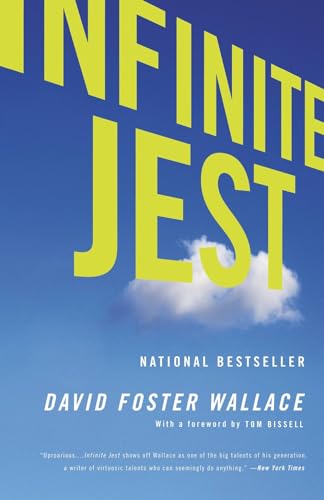
A gargantuan, mind-altering comedy about the Pursuit of Happiness in America Set in an addicts' halfway house and a tennis academy, and featuring the most endearingly screwed-up family to come along in recent fiction, Infinite Jest explores essential questions about what entertainment is and why it has come to so dominate our lives; about how our desire for entertainment affects our need to connect with other people; and about what the pleasures we choose say about who we are. Equal parts philosophical quest and screwball comedy, Infinite Jest bends every rule of fiction without sacrificing for a moment its own entertainment value. It is an exuberant, uniquely American exploration of the passions that make us human -- and one of those rare books that renew the idea of what a novel can do. With a foreword by Tom Bisell. "The next step in fiction...Edgy, accurate, and darkly witty...Think Beckett, think Pynchon, think Gaddis. Think." --Sven Birkerts, The Atlantic
BUY THE BOOK
Join a book club that is reading Infinite Jest!
Community Reviews
What is there to say about this book that hasn't already been said. I mean all the words have already been said IN the book, including the footnotes.
Basically, this book is about addiction, and I'm addicted to it and the way it portrays the ways we are obsessed with things on a micro and a macro level. DFW REALLY UNDERSTANDS ME *cries*
10/10 good job, David. Uh...sorry writing one of the greatest novels of all time didn't help you with the depression thing. That sucks. Thanks for writing this before you offed yourself though.

I enjoyed a lot of different parts of this. But not all. That's not unusual for a long novel. However, with a 1000 page novel, the annoying parts feel especially galling because you're sitting there thinking - plenty of other classics have made truly groundbreaking art without having to waste so much of my time. If you're so smart, why can't you?
The only saving grace, and the only thing that got me to finish the damn thing, was of course the humor. I've heard interviews where DFW said that was intentional. That he knew he would need to make the novel entertaining in order to persuade his readers to actually read it.
But there's also a lot of repetitive humor - the same types of jokes played repeatedly lose their force over time. In particular, I found his use of humoristic style, or style crafted to be humorous, to be annoying: the comically long sentences and digressions followed with a knowing wink, the use of obscure slang that I don't think anyone has ever actually used in real life (de-mapped? howling fantods?) and shorthands that get repeated so much that the joke underlying them loses all humor ("the moms", "himself"), the absurd situations playing out like a jerry springer stage show, the constant absurd descriptions of mental states, especially highs, and the tortured syntax (using "which" as an all purpose conjunction for parenthetical glue-on digressions, "but and so" as the starter to a sentence, etc.). ... All of these things work until they don't. And in a 1000 page novel, it's a foregone conclusion you're going to reach that point and then go past it and then eventually get to the point again after circling the globe.
And really this should be FOUR novels, not ONE. There should be individual novels for the tennis academy, the rehab house, and the national satire. And then there should be a fourth novel where they all intersect, which by the way, only BARELY happens in this ONE novel behemoth. And yeah there's some thematic overlap, but not near enough.
And footnotes are just ways of including things that should be cut. They just are.
At the end of the day, DFW has no self-control. He has a massive ego, for all his humble protestations to the contrary, and clearly needed an editor to deflate some of his pretentions to make a better novel. I've read all his short stories and most of his essays and they ALL have the same problems. He just can't make decisions, and he does not respect his readers or value their time.
And yet Infinite Jest does have some very very affecting storylines. Some very funny moments. Some great philosophical ruminations. I just don't think it's a great piece of art in the way its reputation suggests.
As a postscript of sorts, I would like to add a personal note. I smoked for a couple years. Quit cold turkey. Took two tries, but it worked. I at one point smoked pot every night for insomnia from pain. Eventually it got to be a problem because of side effects - I could get to sleep but I couldn't sleep well and so I was tired all the time. So I quit. Took a while to decide, but once I did, I quit cold turkey. No problem.
I say all this, but I would never ever assume that just because it was easy for ME to quit addicting substances, that therefore it would be easy for others.
And aside from sharing my own personal connections to the subject matter of IJ, I mention it in order to say this - DFW is clearly an addict in some degree of recovery. And like a lot of people in that position, he projects his own problem onto everyone else. One of the main overarching themes of the novel is the addictive nature of modern life, especially but not only entertainment, and its effects on our psychological and social health, habits, etc. This is highly relevant to today's internet and social media age - even more so than it was in DFW's television age. But despite the rehab house being, to me, the most interesting and emotionally interesting storyline in the novel, it also at times made me uncomfortable with the totalizing, black and white, moralistic way of approaching and describing substances. Not every one has those relationships to those substances. There's also too much heroicization of AA for my taste, however ironically the praise may be presented. There are other far less cult-like organizations and approaches out there - many of which are actually based on science and not dogma. In fact, I am mostly skeptical about AA's role in the novel, and mostly open to the idea of addiction as a major force in contemporary society. But the relationship between the two in the novel really tempered my reception of the storyline even despite the emotional heft of it.
The only saving grace, and the only thing that got me to finish the damn thing, was of course the humor. I've heard interviews where DFW said that was intentional. That he knew he would need to make the novel entertaining in order to persuade his readers to actually read it.
But there's also a lot of repetitive humor - the same types of jokes played repeatedly lose their force over time. In particular, I found his use of humoristic style, or style crafted to be humorous, to be annoying: the comically long sentences and digressions followed with a knowing wink, the use of obscure slang that I don't think anyone has ever actually used in real life (de-mapped? howling fantods?) and shorthands that get repeated so much that the joke underlying them loses all humor ("the moms", "himself"), the absurd situations playing out like a jerry springer stage show, the constant absurd descriptions of mental states, especially highs, and the tortured syntax (using "which" as an all purpose conjunction for parenthetical glue-on digressions, "but and so" as the starter to a sentence, etc.). ... All of these things work until they don't. And in a 1000 page novel, it's a foregone conclusion you're going to reach that point and then go past it and then eventually get to the point again after circling the globe.
And really this should be FOUR novels, not ONE. There should be individual novels for the tennis academy, the rehab house, and the national satire. And then there should be a fourth novel where they all intersect, which by the way, only BARELY happens in this ONE novel behemoth. And yeah there's some thematic overlap, but not near enough.
And footnotes are just ways of including things that should be cut. They just are.
At the end of the day, DFW has no self-control. He has a massive ego, for all his humble protestations to the contrary, and clearly needed an editor to deflate some of his pretentions to make a better novel. I've read all his short stories and most of his essays and they ALL have the same problems. He just can't make decisions, and he does not respect his readers or value their time.
And yet Infinite Jest does have some very very affecting storylines. Some very funny moments. Some great philosophical ruminations. I just don't think it's a great piece of art in the way its reputation suggests.
As a postscript of sorts, I would like to add a personal note. I smoked for a couple years. Quit cold turkey. Took two tries, but it worked. I at one point smoked pot every night for insomnia from pain. Eventually it got to be a problem because of side effects - I could get to sleep but I couldn't sleep well and so I was tired all the time. So I quit. Took a while to decide, but once I did, I quit cold turkey. No problem.
I say all this, but I would never ever assume that just because it was easy for ME to quit addicting substances, that therefore it would be easy for others.
And aside from sharing my own personal connections to the subject matter of IJ, I mention it in order to say this - DFW is clearly an addict in some degree of recovery. And like a lot of people in that position, he projects his own problem onto everyone else. One of the main overarching themes of the novel is the addictive nature of modern life, especially but not only entertainment, and its effects on our psychological and social health, habits, etc. This is highly relevant to today's internet and social media age - even more so than it was in DFW's television age. But despite the rehab house being, to me, the most interesting and emotionally interesting storyline in the novel, it also at times made me uncomfortable with the totalizing, black and white, moralistic way of approaching and describing substances. Not every one has those relationships to those substances. There's also too much heroicization of AA for my taste, however ironically the praise may be presented. There are other far less cult-like organizations and approaches out there - many of which are actually based on science and not dogma. In fact, I am mostly skeptical about AA's role in the novel, and mostly open to the idea of addiction as a major force in contemporary society. But the relationship between the two in the novel really tempered my reception of the storyline even despite the emotional heft of it.
See why thousands of readers are using Bookclubs to stay connected.