Good Inside: A Guide to Becoming the Parent You Want to Be
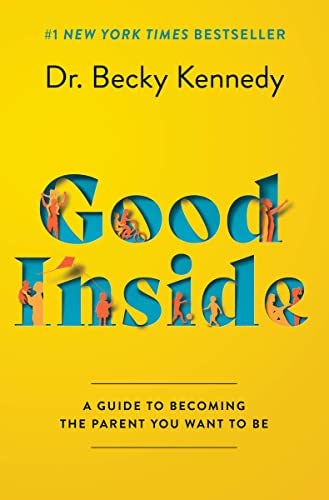
INSTANT #1 NEW YORK TIMES BESTSELLER
An Instant Wall Street Journal, USA Today, and Indie Bestseller
“This book is for any parent who has ever struggled under the substantial weight of caregiving—which is to say, all of us. Good Inside is not only a wise and practical guide to raising resilient, emotionally healthy kids, it’s also a supportive resource for overwhelmed parents who need more compassion and less stress. Dr. Becky is the smart, thoughtful, in-the-trenches parenting expert we’ve been waiting for!”—Eve Rodsky, New York Times bestselling author of Fair Play and Find Your Unicorn Space
Dr. Becky Kennedy, wildly popular parenting expert and creator of @drbeckyatgoodinside, shares her groundbreaking approach to raising kids and offers practical strategies for parenting in a way that feels good.
Over the past several years, Dr. Becky Kennedy—known to her followers as “Dr. Becky”—has been sparking a parenting revolution. Millions of parents, tired of following advice that either doesn’t work or simply doesn’t feel good, have embraced Dr. Becky’s empowering and effective approach, a model that prioritizes connecting with our kids over correcting them.
Parents have long been sold a model of childrearing that simply doesn’t work. From reward charts to time outs, many popular parenting approaches are based on shaping behavior, not raising humans. These techniques don’t build the skills kids need for life, or account for their complex emotional needs. Add to that parents’ complicated relationships with their own upbringings, and it’s easy to see why so many caretakers feel lost, burned out, and worried they’re failing their kids. In Good Inside, Dr. Becky shares her parenting philosophy, complete with actionable strategies, that will help parents move from uncertainty and self-blame to confidence and sturdy leadership.
Offering perspective-shifting parenting principles and troubleshooting for specific scenarios—including sibling rivalry, separation anxiety, tantrums, and more—Good Inside is a comprehensive resource for a generation of parents looking for a new way to raise their kids while still setting them up for a lifetime of self-regulation, confidence, and resilience.
BUY THE BOOK
Community Reviews

This is my favorite parenting book. I cannot tell you how grateful I feel to have read it. The author starts with the premise that children are prosocial. That they would like to relate, belong, and conform to group norms. She then asks why they do not?
She concludes the answer is not out of malice, but rather inexperience. They face a baffling array of new challenges, from emotions to social dynamics to disappointments to guilt and sorrow. They confront this cacophony not with the calm poise of an experienced 35 year old that can recognize these feelings as temporary. Rather they confront these feelings with abject confusion and terror.
If that's the case, what role for the parent? Shepherd. Consoler. Caring authority figure. The goal is to help the kid navigate these treacherous waters. And you should focus your attention on that, rather than worrying too much about whether the child does this or that *right now*.
I cannot tell you how touched I have been by the lessons of this book and incorporating them into my parenting instinct. Honestly, I'm just so grateful to the author for putting this into the world.
FIVE STARS. The embodiment of the parent I feel called to be.
Here are my favorite quotes:
1. "Research has shown that therapy for the parent is more effective at improving childhood behavior than therapy for the child. This is because much of a child’s development is simply a reflection of the behaviors and reactions they see in their parents." Real look in the mirror check.
2. "Childhood should teach you to how to have feelings and manage them. To find yourself amidst feelings and urges rather than have urges overtake you." At this point in the book, I'm suddenly thinking mainly about my own childhood and did I learn this and nope I didn't learn this and does that explain the hardest experiences of my adult life? Yeah, geez, it sorta does. How motivated am I to help my kids with this.
3. "You can’t prioritize the perfect outcome. You should prioritize growth and attachment." Stop. Reverse. Re-read. You can't prioritize the OUTCOME. Holy shit. I don't even think I knew that was possible. And by the way, some of you are probably thinking - but if you don't prioritize the outcome you're teaching the kid they can fail? I disagree completely. I've been doing this for a year and what happens is the kid takes personal responsibility for things *because* they give a shit about you and your relationship with them and they don't want to let you down. So you get hte outcome AND you get an amazing, heartwarming relationship with your child.
4. "Parenthood is a journey of personal development. We have to confront our childhood and our own patterns and tendencies while also caring for another." This is exactly how I feel about parenting. It's constant. The flashbacks to your own childhood. You either become psychologically comfortable with your childhood or you pass on a lot of weird shit to your kid. It's either or.
5. "More powerful than memorizing a script, be guided by one question: am I helping my kid tolerate and work thru this or avoid and get away from thus."
6. "Behavior is not the main event. That is the underlying emotions and feelings that bring about the behavior. If you just focus on adjusting the behavior, your success will be limited and short lived. If you can connect with the underlying feeling, then you can work on resolving the issue."
7. "When we control our kids with charts and punishments, we give up a chance to connect with our kids and instead tell them their behavioral compliance is all that matters." Kids are instinctual. They have not yet learned to mediate the world through the conscious minds, yet. They engage less self consciously. Charts deny that reality. Punishments diminish it. Be with your kid as they are. Communicate about what they actually care about. Forget communicate an hold their hand and acknowledge it can be hard to be frustrated and you would be frustrated by the same experience. Let them know you can understand these terrible feelings they are having. That they are not alone in confronting them. Through your presence and engagement more than your words.
8. "We can parent with firm expectations AND be playful. We can say no AND be worried about our kids feelings." Kids DO NOT care about contradictions. They are just engaged. If you tell them they can't do something and dance around with them while doing it - they can accept the no and enjoy the dance. Adults could do this too if we weren't so in our heads. But we are, so it's best to keep this to kids.
She concludes the answer is not out of malice, but rather inexperience. They face a baffling array of new challenges, from emotions to social dynamics to disappointments to guilt and sorrow. They confront this cacophony not with the calm poise of an experienced 35 year old that can recognize these feelings as temporary. Rather they confront these feelings with abject confusion and terror.
If that's the case, what role for the parent? Shepherd. Consoler. Caring authority figure. The goal is to help the kid navigate these treacherous waters. And you should focus your attention on that, rather than worrying too much about whether the child does this or that *right now*.
I cannot tell you how touched I have been by the lessons of this book and incorporating them into my parenting instinct. Honestly, I'm just so grateful to the author for putting this into the world.
FIVE STARS. The embodiment of the parent I feel called to be.
Here are my favorite quotes:
1. "Research has shown that therapy for the parent is more effective at improving childhood behavior than therapy for the child. This is because much of a child’s development is simply a reflection of the behaviors and reactions they see in their parents." Real look in the mirror check.
2. "Childhood should teach you to how to have feelings and manage them. To find yourself amidst feelings and urges rather than have urges overtake you." At this point in the book, I'm suddenly thinking mainly about my own childhood and did I learn this and nope I didn't learn this and does that explain the hardest experiences of my adult life? Yeah, geez, it sorta does. How motivated am I to help my kids with this.
3. "You can’t prioritize the perfect outcome. You should prioritize growth and attachment." Stop. Reverse. Re-read. You can't prioritize the OUTCOME. Holy shit. I don't even think I knew that was possible. And by the way, some of you are probably thinking - but if you don't prioritize the outcome you're teaching the kid they can fail? I disagree completely. I've been doing this for a year and what happens is the kid takes personal responsibility for things *because* they give a shit about you and your relationship with them and they don't want to let you down. So you get hte outcome AND you get an amazing, heartwarming relationship with your child.
4. "Parenthood is a journey of personal development. We have to confront our childhood and our own patterns and tendencies while also caring for another." This is exactly how I feel about parenting. It's constant. The flashbacks to your own childhood. You either become psychologically comfortable with your childhood or you pass on a lot of weird shit to your kid. It's either or.
5. "More powerful than memorizing a script, be guided by one question: am I helping my kid tolerate and work thru this or avoid and get away from thus."
6. "Behavior is not the main event. That is the underlying emotions and feelings that bring about the behavior. If you just focus on adjusting the behavior, your success will be limited and short lived. If you can connect with the underlying feeling, then you can work on resolving the issue."
7. "When we control our kids with charts and punishments, we give up a chance to connect with our kids and instead tell them their behavioral compliance is all that matters." Kids are instinctual. They have not yet learned to mediate the world through the conscious minds, yet. They engage less self consciously. Charts deny that reality. Punishments diminish it. Be with your kid as they are. Communicate about what they actually care about. Forget communicate an hold their hand and acknowledge it can be hard to be frustrated and you would be frustrated by the same experience. Let them know you can understand these terrible feelings they are having. That they are not alone in confronting them. Through your presence and engagement more than your words.
8. "We can parent with firm expectations AND be playful. We can say no AND be worried about our kids feelings." Kids DO NOT care about contradictions. They are just engaged. If you tell them they can't do something and dance around with them while doing it - they can accept the no and enjoy the dance. Adults could do this too if we weren't so in our heads. But we are, so it's best to keep this to kids.
See why thousands of readers are using Bookclubs to stay connected.