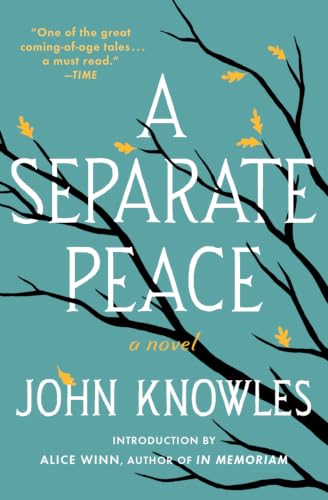
A Separate Peace

Nominated as one of America’s best-loved novels by PBS’s The Great American Read.
An American classic and great bestseller for over thirty years, A Separate Peace is timeless in its description of adolescence during a period when the entire country was losing its innocence to World War II.
Set at a boys' boarding school in New England during the early years of World War II, A Separate Peace is a harrowing and luminous parable of the dark side of adolescence. Gene is a lonely, introverted intellectual. Phineas is a handsome, taunting, daredevil athlete. What happens between the two friends one summer, like the war itself, banishes the innocence of these boys and their world.
An American classic and great bestseller for over thirty years, A Separate Peace is timeless in its description of adolescence during a period when the entire country was losing its innocence to World War II.
Set at a boys' boarding school in New England during the early years of World War II, A Separate Peace is a harrowing and luminous parable of the dark side of adolescence. Gene is a lonely, introverted intellectual. Phineas is a handsome, taunting, daredevil athlete. What happens between the two friends one summer, like the war itself, banishes the innocence of these boys and their world.
BUY THE BOOK
Community Reviews
A timeless description of adolescent boys and loss of innocence. Set in a New Hampshire boys' school during WWII.
Great writing, but S L O W. It felt like a chore to read.
This is one of those rare books that made me want to live and show up in my life differently.
this abridged audiobook was okay but I'm gonna need to listen to the unabridged. always loved this story.
John Knowles’s book at first glance seems like a quick read. Sitting at a comfortable if not light 192 pages, it doesn’t depict itself as any kind of adversary− something you could pick up and for some of us, read in a fortnight or two, drop it back on the bookshelf, and be on our way. The story seems speciously simple, starting off with one tiny event characteristic of many a boy’s adolescence (no, nothing sexual). However the repercussions run deep, and the two main protagonists, best friends Gene and Phineas, start questioning who they are in relation to each other and even how they relate to themselves, written in a period where entire nations were also forced to question their own identities, loyalties, and courage in the midst of chaos and clashes on a global stage: the 1940s.
What I loved about the story was that, in addition to Gene and Phineas, the the school positioned itself as the third major character, serving almost as a halfway house, sheltering these boys from the cruel reality that awaits them yet, concurrently, smoothing their transition from boys of academia to men of the war. It was the constant backdrop for their mishaps, mayhem and development. In fact, it made me nostalgic for my own college years. However, the one thing I couldn’t quite wrap my head around was why this book was not narrated in third person omniscient but instead only through Gene.
Gleaning details about Phineas through Gene’s point of view allows you to appreciate the broader understanding you have of Gene but leaves something to be desired of Phineas. You’re like a child in a sea of adults, dodging protruding limbs and bulbous heads to get a better glimpse of the action. And in this book, Phineas is the source of action. Nevertheless, Knowles does a great job imbuing the readers with what life was like for boys on the brink of manhood living in a world on the brink of war.
What I loved about the story was that, in addition to Gene and Phineas, the the school positioned itself as the third major character, serving almost as a halfway house, sheltering these boys from the cruel reality that awaits them yet, concurrently, smoothing their transition from boys of academia to men of the war. It was the constant backdrop for their mishaps, mayhem and development. In fact, it made me nostalgic for my own college years. However, the one thing I couldn’t quite wrap my head around was why this book was not narrated in third person omniscient but instead only through Gene.
Gleaning details about Phineas through Gene’s point of view allows you to appreciate the broader understanding you have of Gene but leaves something to be desired of Phineas. You’re like a child in a sea of adults, dodging protruding limbs and bulbous heads to get a better glimpse of the action. And in this book, Phineas is the source of action. Nevertheless, Knowles does a great job imbuing the readers with what life was like for boys on the brink of manhood living in a world on the brink of war.
See why thousands of readers are using Bookclubs to stay connected.