The Turn Of The Screw: Brentwood Classics Edition (Annotated): The Complete Unabridged Novel with Original Supplementary Material
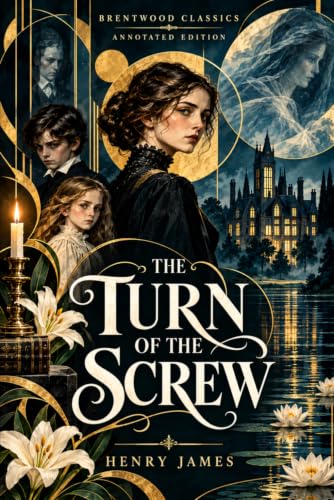
Widely recognized as one of literature's most gripping ghost stories, this classic tale of moral degradation concerns the sinister transformation of two innocent children into flagrant liars and hypocrites. The story begins when a governess arrives at an English country estate to look after Miles, aged ten, and Flora, eight. At first, everything appears normal but then events gradually begin to weave a spell of psychological terror.
One night a ghost appears before the governess. It is the dead lover of Miss Jessel, the former governess. Later, the ghost of Miss Jessel herself appears before the governess and the little girl. Moreover, both the governess and the housekeeper suspect that the two spirits have appeared to the boy in private. The children, however, adamantly refuse to acknowledge the presence of the two spirits, in spite of indications that there is some sort of evil communication going on between the children and the ghosts.
Without resorting to clattering chains, demonic noises, and other melodramatic techniques, this elegantly told tale succeeds in creating an atmosphere of tingling suspense and unspoken horror matched by few other books in the genre. Known for his probing psychological novels dealing with the upper classes, James in this story tried his hand at the occult -- and created a masterpiece of the supernatural that has frightened and delighted readers for nearly a century.
BUY THE BOOK
Community Reviews
This is one of the most pointless things I've ever read. During my read this time I listened to a podcast of a book club discussing it. One of the hosts said that the suspense arises in part from Henry James complicated sentences and vague word choices. That is very astute - there would be essentially no story if the characters just asked straightforward questions and the narrator, when writing the interior thoughts of the main character, didn't constantly rely on insanely vague and repetitive statements. I had remembered going into this that I didn't like Henry James much - this is why. He simply cannot say anything concrete. And incidentally my favorite author is Virginia Woolf - so I am no stranger to elusive prose. But when she does it, you feel the poetry of the moment. James has no poetry.
A lot of the suspense of the story also emanates from class and the requirements of polite conversation that seem carried to an absurd degree here. One of the reasons people don't just talk about what's going on is because there's a class barrier. That could be interesting in the hands of a better writer.
Any way, the story essentially boils down to a cycle something like this (in the mind of the narrator) - "I think something weird might happen. Oh look there's something weird. But I can't ask the kids about it. But I'm sure they must know something, therefore they must be in on it. But I can't ask my employer about it, so I will just look for confirmation from my insanely credulous idiot of a co-worker. After all servants aren't supposed to disturb the upper classes - not even as ghosts. Something may or may not have happened to that effect and now no can talk about it except in the vaguest terms possible. Which makes me think something weird might happen. Oh look there's something weird. But I can't ask the kids about it. But I'm sure they must know something, therefore ..."
It's just that. Over and over again. It's a character either actually seeing something and scaring people around her to death or just thinking she saw it.
Somehow a 120 page novella that felt 4 times too long.
