The Last Kingdom (The Saxon Chronicles Series #1)
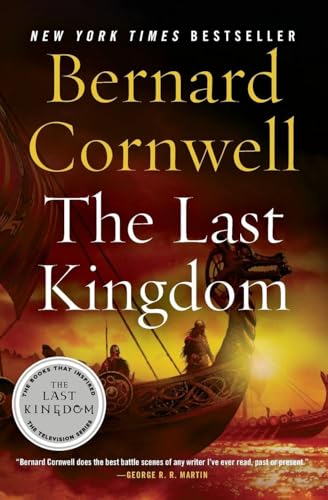
The first installment of Bernard Cornwell’s New York Times bestselling historical fiction series chronicling the epic saga of the making of England, “like Game of Thrones, but real” (The Observer, London)—the basis for The Last Kingdom, the hit Netflix series.

This is the exciting—yet little known—story of the making of England in the 9th and 10th centuries, the years in which King Alfred the Great, his son and grandson defeated the Danish Vikings who had invaded and occupied three of England’s four kingdoms.

The story is seen through the eyes of Uhtred, a dispossessed Saxon nobleman, who is captured as a child by the Danes and then raised by them so that, by the time the Northmen begin their assault on Wessex (Alfred’s kingdom and the last territory in English hands) Uhtred almost thinks of himself as a Dane. He certainly has no love for Alfred, whom he considers a pious weakling and no match for Viking savagery, yet when Alfred unexpectedly defeats the Danes and the Danes themselves turn on Uhtred, he is finally forced to choose sides in a brutal clash of cultures. By now he is a young man, in love, trained to fight and ready to take his place in the dreaded shield wall. Above all, though, he wishes to recover his father’s land, the enchanting fort of Bebbanburg by the wild northern sea, in a relentless blood feud.

This action-packed, thrilling adventure—based on existing records of Bernard Cornwell’s ancestors—depicts a time when law and order were ripped violently apart by a pagan assault on Christian England, an assault that came very close to destroying England.

BUY THE BOOK

Published Jan 3, 2006

368 pages

Average rating: 7.87

38 RATINGS

|

Community Reviews

Rick47
Dec 08, 2025
This is the first novel of a series, and is mirroed in the Netflix series of the same name. It chronicles the quest of King Alfred the Great, beginning in about 900 A.D to push the Vikings out of Great Briitain and to create a unified country that is Christian, not pagan. The lead character, Uhtred Ragnarsson is charismatic, and most of the other characters and battles are drawn directly from history.
memento_momo
Dec 04, 2024
10/10 stars
I’m a big fan of this series in all its forms! I watched the television show on Netflix first (a real winner that pays great respect to the events of these books even as it must abridge them). I adore both. My comment is for any of you folks who have watched the TV show and are debating whether or not to read these books...do it! What I appreciate about these after having watched the television series first is the insight, the careful detail, and that pleasure of actually being inside Uhtred’s mind. Coming across familiar events and dialogue as I made my way through this book was like finding little candies. You learn the significance of “Destiny is all.” You learn more about Ravn and his importance to Uhtred, while he didn’t stick around beyond the first episode of the show. S1 pretty much glossed over Uhtred’s childhood while Uhtred spends the majority of Book 1 being a child, so reading these books, there was so much to learn, so much to be surprised by, and I fell in love with the series all over again, for all the same reasons as well as new ones. You can’t help but notice with every word the love and diligent research that the author Bernard Cornwell put into this great piece of historical fiction. I love the narrative voice he has created for Uhtred, as well. Can I just say, what an amazing character! I’m truly obsessed.
Mrs. Awake Taco
Nov 13, 2024
6/10 stars
Interesting read. I think this would have been better had I not listened to it on audiobook. There were many place names that made listening to it terribly awkward and difficult. I really could have used a map while I was reading this. And also a genealogy. It was hard to keep track of most of the characters. Another "complaint" I had was how brutal and bloody it was. Yeah, yeah, I get it. I am a student of this time period, I know that it wasn't roses and pies. I know that it was this bloody and brutal. But I still didn't enjoy it. I know (from reading Tolkien) that you don't need all that bloody business. I guess it makes it more authentic but it feels unnecessary to me. Or at least so much of it. SO MUCH BLOOD. "And then I pulled Waspsting out, pulling guts out with it." "The axe landed squarely between the eyes." "There was blood in his beard." I'm paraphrasing, but come on, there's just SO MUCH BLOOD. Yuck. I might try the next one because I like this history business, but I might call it quits if there's this same amount of blood. So, yeah, I'd recommend it, but FYI. Not for weak stomachs or conscientious observers.

See why thousands of readers are using Bookclubs to stay connected.