The Demon of Unrest: A Saga of Hubris, Heartbreak, and Heroism at the Dawn of the Civil War
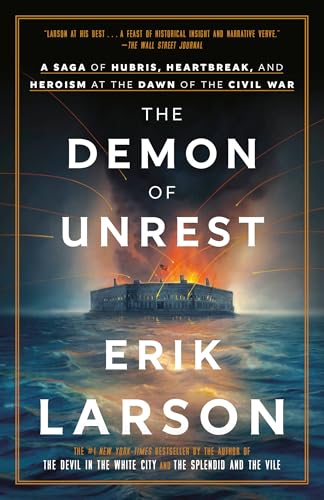
#1 NEW YORK TIMES BESTSELLER • The author of The Splendid and the Vile brings to life the pivotal five months between the election of Abraham Lincoln and the start of the Civil War in this “riveting reexamination of a nation in tumult” (Los Angeles Times).
“A feast of historical insight and narrative verve . . . This is Erik Larson at his best, enlivening even a thrice-told tale into an irresistible thriller.”—The Wall Street Journal
A PARADE BEST BOOK OF THE YEAR
On November 6, 1860, Abraham Lincoln became the fluky victor in a tight race for president. The country was bitterly at odds; Southern extremists were moving ever closer to destroying the Union, with one state after another seceding and Lincoln powerless to stop them. Slavery fueled the conflict, but somehow the passions of North and South came to focus on a lonely federal fortress in Charleston Harbor: Fort Sumter.
Master storyteller Erik Larson offers a gripping account of the chaotic months between Lincoln’s election and the Confederacy’s shelling of Sumter—a period marked by tragic errors and miscommunications, enflamed egos and craven ambitions, personal tragedies and betrayals. Lincoln himself wrote that the trials of these five months were “so great that, could I have anticipated them, I would not have believed it possible to survive them.”
At the heart of this suspense-filled narrative are Major Robert Anderson, Sumter’s commander and a former slave owner sympathetic to the South but loyal to the Union; Edmund Ruffin, a vain and bloodthirsty radical who stirs secessionist ardor at every opportunity; and Mary Boykin Chesnut, wife of a prominent planter, conflicted over both marriage and slavery and seeing parallels between them. In the middle of it all is the overwhelmed Lincoln, battling with his duplicitous secretary of state, William Seward, as he tries desperately to avert a war that he fears is inevitable—one that will eventually kill 750,000 Americans.
Drawing on diaries, secret communiques, slave ledgers, and plantation records, Larson gives us a political horror story that captures the forces that led America to the brink—a dark reminder that we often don’t see a cataclysm coming until it’s too late.
BUY THE BOOK
Community Reviews

The Demon of Unrest is a deeply researched look at the five months between Abraham Lincoln’s election and the bombardment of Fort Sumter. It follows the political failures, secessionist fury, personal ambitions, and moral rot that pushed the United States toward the Civil War. Larson builds his account through figures like Lincoln, James Buchanan, Major Robert Anderson, Edmund Ruffin, and Mary Boykin Chesnut. He places Charleston at the center of a national breaking point.
This book taught me a lot. It also read more like a textbook than a narrative. Larson gives an enormous amount of detail that paints a disturbing picture of the politics, ego, cowardice, and pro-slavery extremism that shaped the start of the Civil War. I did not feel pulled toward the people on the page the way I usually do with narrative nonfiction, but I did feel pulled toward learning more. That says something.
I visit Charleston often. I have stayed at the Mills House, walked the Battery, strolled King Street, toured historic homes, visited the Market, and stood inside the Old Slave Mart Museum with tears in my eyes. Reading this made me realize how much gets polished, softened, or left off the plaques. Some of the major players in Charleston history were proudly awful. Larson made me look at the history of a city I love with new eyes.
President Lincoln surprised me too. I knew the broad strokes. I did not realize how much of the crisis he inherited from former President Buchanan or how many attempts at mediation happened before the war began. Lincoln comes across as thoughtful, funny, careful, and aware of the weight of his choices. His open door policy after being smuggled into Washington because of assassination threats was fascinating. He wanted his presidency to feel accessible and not hidden behind fear. I have to say it is safe to assume his later assassination was enabled by this open door policy.
The Demon of Unrest did not sweep me away, but it expanded my understanding. It made me painfully aware of how much my education left out about slavery, secession, and the start of the Civil War. This is not a light read and it is not a character-driven page-turner. It is dense, meticulous, and sobering. Readers who love Civil War history, political history, Charleston history, or heavily researched nonfiction will find plenty to chew on here.
See why thousands of readers are using Bookclubs to stay connected.