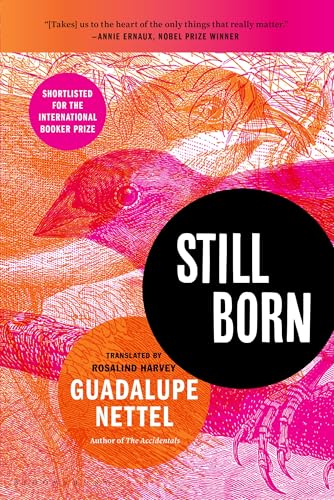
Still Born
"Both uplifting and gut-wrenching, often at the same time . . . At its heart, it is a story about the many different ways to be a family, and it made me reflect on what an honor it is to care for someone you truly love.” -Dua Lipa
Shortlisted for the 2023 International Booker Prize
A profound novel about motherhood, friendship, and the power of community from “one of the leading lights in contemporary Latin American literature” (Valeria Luiselli, author of Lost Children Archive).
Alina and Laura are independent and career-driven women in their mid-thirties, neither of whom have built their future around the prospect of a family. Laura is so determined not to become a mother that she has taken the drastic decision to have her tubes tied. But when she announces this to her friend, she learns that Alina has made the opposite decision and is preparing to have a child of her own.
Alina's pregnancy shakes the women's lives, first creating distance and then a remarkable closeness between them. When Alina's daughter survives childbirth – after a diagnosis that predicted the opposite – and Laura becomes attached to her neighbor's son, both women are forced to reckon with the complexity of their emotions, their needs, and the needs of the people who are dependent upon them.
In prose that is as gripping as it is insightful, Guadalupe Nettel explores maternal ambivalence with a surgeon's touch, carefully dissecting the contradictions that make up the lived experiences of women.
BUY THE BOOK
Community Reviews

“Motherhood has always been very porous. The females of lots of other species take care of other females’ young.” Dolphins “have several godmothers who accompany the mother while she’s giving birth and then help her raise her offspring for the first few years. Some birds “lay their eggs in strange nests where the female of another species has already laid her own…sometimes children come to us without us having planned it…as if someone had deposited an egg in our nest.”
“The biological family is something that’s been imposed on us, and it’s high time we stopped glorifying it. There’s no reason we should settle for that if it doesn’t work for us.” Women have “always looked after other women’s children, and there are always other women who help us take care of our own. Naturally connections are going to be made between children and these substitute mothers.” “Children get more attached to the women who care for them than to their own mothers.”
Education was “the substitution for motherhood [I] had happened upon: being the pretend mother of one [group of children] after another, loving them intensely” as if they were my own, and then, at the end of nine months, preparing for a new class family. Being a teacher “requires a very distinctive character. The role is not one just anyone can do. You need a great deal of energy, responsibility, common sense and, above all, to be in love with the child.” A teacher is able to transmit “an easy, disinterested love, that light and simultaneously intense love of someone who is not obliged to stay” but can go home at the end of the day.
“Motherhood is a social commandment…And in almost every case, it stops women from making something of their lives. You have to be very convinced you want to be a mother before taking that kind of gamble.” Instead, I chose to be a “mother” by day and become a doctor by night/summer. Instead of a baby like Alina, I’m birthing a dissertation like Laura, investing my education to improve the education of the next generation of children.
Guadalupe Nettel’s latest novel is proof that motherhood is a state of mind and birth is a state of being. Every day we are Still Born: “Sometimes we need to practise our entire lives to find it.”
One of the few books that discusses the plights and joys of different kinds of motherhood, along with focusing on meaningful female friendship and kinship. I don't have many flaws to discuss about this book, but one of the things that bothered me was the Mexican-ness of the central characters, namely Alina and Laura. From the way they talk about various forms of media and art, one would mistake them for being European. The lack of discussion on Mexican artists made me suspicious. Also, I was not a fan of the classic "wife getting suspicious of the nanny" trope. I thought it wouldn't appear, but it did. Although Marlin and Alina's understanding became more conclusive and empathetic later on, I cringed at it. Other than these issues, I am very happy that the book explores different perspectives and circumstances of being a mother or not being one. The nuanced exploration of such complex scenarios surrounding motherhood has also made this book stand out more to me.
4.25/5
4.25/5
A very quick read. I wasn’t sure how I felt about a lot of the topics. I suppose it’d be a great book for a literary or women’s issues course. It leaves a lot to be desired. There’s promise there, but I needed more. More connections, more resolutions… happy to be finished. Not really what I expected.
See why thousands of readers are using Bookclubs to stay connected.