Open Borders: The Science and Ethics of Immigration
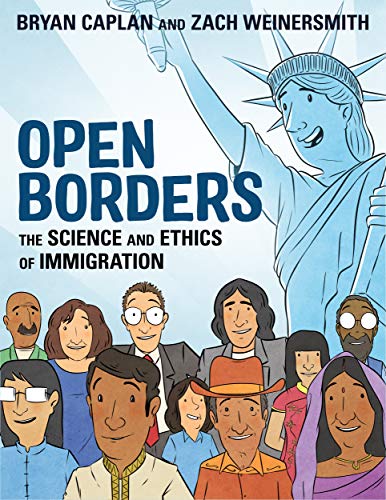
An Economist “Our Books of the Year” Selection
Economist Bryan Caplan makes a bold case for unrestricted immigration in this fact-filled graphic nonfiction.
American policy-makers have long been locked in a heated battle over whether, how many, and what kind of immigrants to allow to live and work in the country. Those in favor of welcoming more immigrants often cite humanitarian reasons, while those in favor of more restrictive laws argue the need to protect native citizens.
But economist Bryan Caplan adds a new, compelling perspective to the immigration debate: He argues that opening all borders could eliminate absolute poverty worldwide and usher in a booming worldwide economy—greatly benefiting humanity.
With a clear and conversational tone, exhaustive research, and vibrant illustrations by Zach Weinersmith, Open Borders makes the case for unrestricted immigration easy to follow and hard to deny.
BUY THE BOOK
Community Reviews
I'll go over the book page for page and point out all the logical fallacies in it but I need a place where I can upload images for that so I won't do that on Goodreads. Very weird that such a huge site doesn't have this option… I can't explain it.
Pro
Many libertarians are against closed borders as they want free movement of workers so that companies can increase their profits. Caplan is one of them and it's for me an understandable standpoint so I kinda see where he is coming from. Unfortunately he doesn't just stick to the data and factual claims of this strong argument he wanders into weird and loose arguments. But the book is not at all without strong points.
This book is a defense of immigration based on logical arguments. This makes it a very rare book in this genre. Usually these type of pro immigrants books are focused on emotional appeal as most of these books are written by progressives that don't tend to use logical arguments to the same degree as less ideological groups. Those progressive books try to make you feel terrible if you don't support their ideological claims. Caplan is more relaxed and logical about it. This book never feels like a direct attack on anything or anyone. It does feel like he actually wanted to debate the topic largely on academic terms, but just didn't quite achieve that.
So he is doing the left a huge favor and the left will love him back in return for it as they finally have one decent book pro one of their main augments. This is the sort of book that makes you a hero in some ideological circles. The book artist is a progressive left-winger himself and has some left-wing ideological stuff he writes and draws. So this combination of libertarian and left-wing ideas is interesting. On the other hand I don't think the ideas the left has is meant to be described and measured in detail as that would mean that anyone could start applying simple math and logic to dispute their claims. So maybe some of the left won't really love such a project?
For us amoral outsiders it's still a needed piece of work as now we can study the arguments and attack them with logic one by one. Most for the arguments in this book can be easily disproven or shown to be overly simplified real life data. But then there is not much the writer can do here in a book called Open Borders. He has to somehow argue for the main claim at all times and if that's impossible at some point he still has to try. He set up this trap for himself and fell right into it. He tries his very best to somehow flip things around and manipulate logic and data to make this book work. It's both cringe-worthy and admirable as it takes a huge amount of intellect to create these weird and often nonsensical arguments. So while this book is very ideological I do think he initially wanted to make it a mainly evidence based book.
If his views are as ideological as presented in this book he will never change his mind on anything. If he is willing to take a step further into the logical world I think he will change his mind and maybe even dismiss this book outright at some point.
I assume most progressive public school teachers would love such pro-multicultural book they can force their students to read. And frankly it's not the worst book to read if you are extremely critical and good at spotting bad faith arguments. If you don't consider yourself a mini-expert on logical arguments then avoid it because it's great manipulation only showing one side of the argument in a fair light while presenting the counterview in a silly and stupid way.
Con
It's easy to win all your debates when you are debating idiots you invented to hold the opposite point of view. The Caplan character on the pages completely wipes the floor with the greatest intellectuals he can find. They all seemingly become bumbling fools here. For example, Milton Friedman is presented a short gnome (152 cm in real life). His opinions are molded into narrow-minded xenophobic views. Now, I've seen Milton's really great documentary series. It's still maybe the best macro economy intro out there. His writing is good too. His real arguments and then his character's arguments in this book are 2 vastly different things. Of course you can't present his full arguments in a short book but you can present stronger arguments on the pages you have. In real life Milton is one of the greatest intellectuals of the 20th century and would win 9 out of 10 debates with Caplan no matter how smart Caplan think he is. Imagine this comic book being fair to all sides. Caplan would be losing 60% of these debates and his character would stop smirking. It's just irritating to read a book while knowing the full arguments and then thinking "This is surely where Caplan must admit a tiny defeat soon?" But no, he has one point of view and that's it. The full arguments are only presented if he has an easy rebuttal ready. If he doesn't then he uses a strawman argument instead.
Basically, this book doesn't present full or fair counter-arguments. They are all shrunk down into mini-strawman arguments that only reveal just a tiny bit of their scope. If this book came in 2-parts I'd rate both 5/5. Then the sequel would have another author, who is anti open borders, present all these debates from his point of view. It would make it a really great and fair debate. Where is that anti open borders comic book though? A one-sided argument is worth half of its full value. It's not bad as such but it's just misleading and maybe harmful if less intellectual readers think this is the full picture and final word on the issue.
Very few are seriously complaining about high IQ immigrants so no wonder he wins all his debates when he ignores the main counter-argument. When he is clearly losing any one argument he just goes back to his claim of "the world economy will improve with full open borders". So the book never gets interesting. The bad arguments are taken apart. The good arguments are "defeated" with this one single repetitive counterclaim. Even for progressive leftists this is surely not acceptable
I'm glad Caplan has a great national IQ map in the book and tackles the best argument anti immigration. But he knows the full argument about race and IQ and he dodges it. There is no excuse for it. If you avoid the biggest counter-argument then you just don't understand the topic well enough to write a long book about it. In the book Caplan very often mixes "only low IQ groups" arguments with "all current immigration groups" arguments. Those are 2 vastly different things! Obviously when immigrants are selected the overall IQ will be much higher. If the borders are fully open the immigrant groups will have much lower IQ meaning that he will need to redo all his math. I know he doesn't want to do it in this book but it's just a fair thing to do. These low IQ immigrant groups reproduce faster, have extreme crime rates in the Western world and have very high unemployment rates. And this is consistent over time. None of these claims are touched in the book. If they were he would not have a response to any of this.
This book is also only relevant to USA. Most of his data claims only show positive outcomes for USA. Doing the same math for basically any other Western country would reveal very negative results. So this is not really a book pro open borders in general. It's not at all about Europe, Africa, China or Japan. The logical problem here is of course that USA is not close to Africa. The African immigrants, the lowest IQ immigrant group, is an economic disaster for European nations. Open borders in Europe is currently a huge disaster. The cost of getting to USA from Africa means that the extremely low IQ immigration to USA is more rare and all his math is way more positive than it would be for basically any other rich country with no great ocean between them and Africa. His math applies to Canada, USA and maybe far away countries like New Zealand and Australia. And then when you also take account of him picking the best data while ignoring the negative numbers I'm not sure the positive results are even that clear for USA alone.
Another example that yet again makes this book largely irrelevant to Europeans is his voting argument. His main argument for taking in groups with anti-Western opinions is that immigrants don't vote as much anyhow so it doesn't matter what crazy stuff they think or feel. Well, maybe that's fine for USA where the immigrants just have stronger antidemocratic ideas and higher crime rates. For Europe it's a totally different picture. The extremist Muslims may not vote much but when they do it's often pro parties that want to change the society and abolish Western values. And furthermore, they are destructive in the countries themselves. Anyone who has spent any time in Europe understands how extremely destructive some groups are. I'm not saying extreme Muslims will forever be extreme and criminal, but it is the case right now. Maybe in 100 years they will be less extreme and then only their lower IQ will matter to the immigration argument. For me it doesn't matter that much if they vote or not if they steal my bikes and throw garbage on the street.
But my main issue with this book is maybe even that it's not that interesting. It's just a ton of small arguments. It was too long and didn't have a clear structure to it so it felt like reading jokes without punchlines. Caplan unfortunately doesn't have a clear claim to make as he picks whatever he can sling at the counterclaim. And it makes it clear that the topic and book are forced onto that pages instead of being a relaxed neutral debate. The open borders argument is not just a bunch or pro points in real life. There are positives and negatives, but this book makes it seem like the debate is one-sided and that there is no good counterclaim.
Conclusion
It's a double-edged sword. A lot of the book is deep, intellectual and presents new ideas. But the main topic of the book is Caplan attacking silly strawman arguments.
If the illustrator at some point illustrates a book anti open borders I'll go back to this book and review it in a less critical light as I'll see it as part of a full picture.
Obviously open borders for high IQ immigrants is good most of the time. I think most people would agree with that. A high IQ Chinese immigrant immigrating to Greece is a huge plus for Greece. But low IQ Somalies immigrating to Sweden? I haven't seen any stats showing that to be a positive. And Caplan just cleverly obscures the question the same way he avoids most stats showing anything negative about immigrants.
This book is also pretty much irrelevant for anyone outside USA just interested in general open borders arguments and not just a single country with only 1 critical border. For a French or German citizen this book will contain stats irrelevant to their country as it avoids the questions related to African and Muslim immigrants. Caplan has made this debate waaaay too easy for himself. He basically avoids the critical questions.

A friend recommended this book to me, and I was pleasantly surprised to find that it was a graphic novel, a medium I hadn't explored much before. As someone without a strong preconceived opinion on the topic, I approached it with an open mind.
What struck me most about this book was the author's ability to make a compelling case for open borders while methodically addressing objections one by one. The format of a graphic novel made the complex subject matter accessible and easy to consume.
While the arguments presented are convincing, there were moments when I wished for a deeper dive into the sources to substantiate these claims. Fortunately, the author provides an extensive list of notes and citations at the end of the book for further exploration.
Whether you're a seasoned advocate for open borders or someone like me, entering the discussion without a fixed opinion, this graphic novel provides valuable insights and is sure to spark thoughtful conversations.
See why thousands of readers are using Bookclubs to stay connected.