Mindhunter: Inside the FBI's Elite Serial Crime Unit
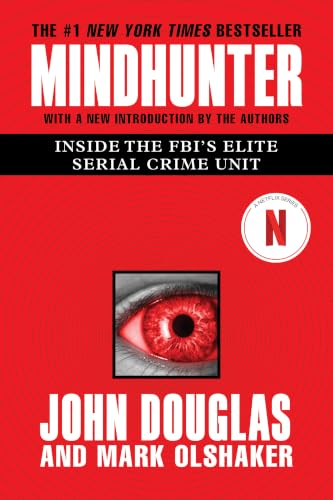
Now a Netflix original series
Discover the classic, behind-the-scenes chronicle of John E. Douglas’ twenty-five-year career in the FBI Investigative Support Unit, where he used psychological profiling to delve into the minds of the country’s most notorious serial killers and criminals.
In chilling detail, the legendary Mindhunter takes us behind the scenes of some of his most gruesome, fascinating, and challenging cases—and into the darkest recesses of our worst nightmares.
During his twenty-five year career with the Investigative Support Unit, Special Agent John Douglas became a legendary figure in law enforcement, pursuing some of the most notorious and sadistic serial killers of our time: the man who hunted prostitutes for sport in the woods of Alaska, the Atlanta child murderer, and Seattle's Green River killer, the case that nearly cost Douglas his life.
As the model for Jack Crawford in The Silence of the Lambs, Douglas has confronted, interviewed, and studied scores of serial killers and assassins, including Charles Manson, Ted Bundy, and Ed Gein, who dressed himself in his victims' peeled skin. Using his uncanny ability to become both predator and prey, Douglas examines each crime scene, reliving both the killer's and the victim's actions in his mind, creating their profiles, describing their habits, and predicting their next moves.
BUY THE BOOK
Community Reviews
What Bookclubbers are saying about this book
✨ Summarized by Bookclubs AI
Readers say *Mindhunter* offers a fascinating, detailed look into the FBI’s pioneering work in criminal profiling, blending true crime storytelling wi...
Mindhunter by John Douglas and Mark Olshaker is a fascinating look into the early days of FBI criminal profiling. Drawing on real cases and interviews with notorious serial killers, Douglas explores the psychology behind violent crime and how behavioral patterns can help catch offenders. Dark, insightful, and sometimes chilling, it’s an essential read for true crime fans who are more interested in the why than just the what.

I really enjoyed reading Mindhunter by John Douglas. This book was fascinating because it gives readers an inside look at how the FBI began studying the minds and behaviors of violent criminals. Instead of feeling like a textbook, it reads like a suspenseful true-crime story filled with real investigations and the challenges faced by law enforcement.
What I found most interesting was how Douglas explains the process of criminal profiling and how investigators use behavioral clues to understand offenders and solve cases. The book does not focus only on crimes; it also explores the psychology behind criminal behavior, which made it both educational and engaging.
Douglas writes in a way that is easy to understand, even when discussing complex topics. His firsthand experiences and encounters with notorious criminals make the book feel authentic and compelling. Each chapter kept me interested because I was constantly learning something new about criminal investigations and the development of modern profiling techniques.
One quote that stood out to me was, “Behavior reflects personality.” This simple idea is at the heart of the book and helps explain how investigators can learn so much about a person through the evidence they leave behind.
Overall, Mindhunter was a captivating and thought-provoking read. I would highly recommend it to anyone interested in true crime, psychology, or criminal investigations. It offers a unique perspective on how investigators work to understand and catch some of the most dangerous criminals, making it difficult to put down.
Most true crime books focus on the killers. Mindhunter focuses on the people trying to understand them. Mindhunter is a fascinating look at how criminal profiling evolved from a fringe idea into a revolutionary investigative tool.
Douglas takes readers through his career with the FBI's Behavioral Science Unit by explaining how he interviewed some of America's most infamous serial killers. Douglas used those conversations to identify patterns in violent behavior. Then, he shows the painstaking process behind the development of profiling rather than presenting it as a mysterious gift. Every crime scene detail, victim choice, behavioral pattern, and interview technique becomes another piece of a psychological puzzle. The book follows both his professional development and the growth of a field that permanently changed modern investigations.
What impressed me most was Douglas's ability to make complex psychological concepts accessible. Nearly every chapter offered a new insight into human behavior, criminal motivation, interrogation strategy, or investigative reasoning. He explains how experienced interviewers learn to avoid power struggles with offenders, how seemingly insignificant observations can reveal larger behavioral patterns, and how profiling became a practical investigative resource rather than an academic theory. I found myself highlighting mental notes constantly because each case seemed to contain another lesson about human psychology.
The book also benefits from Douglas's willingness to discuss mistakes. He openly examines cases where assumptions proved incorrect and how those failures improved his methods. His self-reflection prevents the memoir from feeling self-congratulatory. Instead, it reads like a professional sharing decades of hard-earned experience and inviting readers into the learning process.
Some readers will likely disagree with portions of Douglas's philosophy regarding rehabilitation and violent offenders. His perspective is shaped by decades spent studying and interviewing individuals responsible for horrific crimes. Whether readers agree with every conclusion or not, his arguments are presented thoughtfully and supported by examples from his career. The book encourages critical thinking rather than offering simplistic answers.
The content is undeniably graphic at times. Douglas discusses murder, sexual violence, child victims, and some of the most disturbing crimes investigated during his career. These details serve an educational purpose rather than a sensational one. Though readers sensitive to true crime content should approach with caution.
The audiobook narration by Richard M. Davidson was excellent. He handles the material with professionalism and restraint by never turning tragedy into performance. His pacing allows difficult moments to be shared appropriately while voicing the narrative. The delivery felt respectful, measured, and perfectly suited to the subject matter.
I was also pleasantly surprised by how closely the television adaptation followed the source material. Many adaptations borrow ideas while losing the heart of the original work. Mindhunter preserves much of what makes the book compelling. I think the TV adapatation is one of the strongest book-to-screen adaptations I have encountered.
Mindhunter succeeds because it is far more than a catalog of infamous criminals. It is a memoir of intellectual curiosity, a history of criminal profiling, and a fascinating exploration of how investigators learned to understand the darkest corners of human behavior. I finished feeling educated, challenged, and eager to revisit many of the lessons Douglas shares throughout the book. Pick this up if you love true crime, criminal profiling, forensic psychology, FBI investigations, or want a fascinating look at how investigators learned to think like serial killers in order to catch them.
See why thousands of readers are using Bookclubs to stay connected.