Let Me Tell You What I Mean
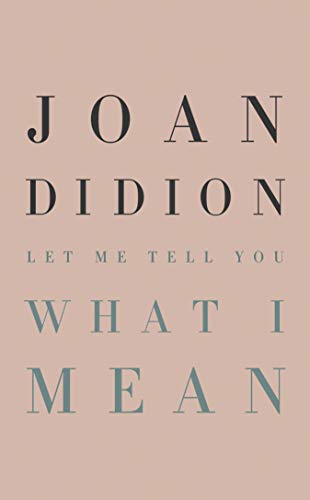
A NEW YORK TIMES NOTABLE BOOK OF THE YEAR • NEW YORK TIMES BEST SELLER • From one of our most iconic and influential writers, the award-winning author of The Year of Magical Thinking: a timeless collection of mostly early pieces that reveal what would become Joan Didion's subjects, including the press, politics, California robber barons, women, and her own self-doubt.
With a forward by Hilton Als, these twelve pieces from 1968 to 2000, never before gathered together, offer an illuminating glimpse into the mind and process of a legendary figure. They showcase Joan Didion's incisive reporting, her empathetic gaze, and her role as "an articulate witness to the most stubborn and intractable truths of our time" (The New York Times Book Review).
Here, Didion touches on topics ranging from newspapers ("the problem is not so much whether one trusts the news as to whether one finds it"), to the fantasy of San Simeon, to not getting into Stanford. In "Why I Write," Didion ponders the act of writing: "I write entirely to find out what I'm thinking, what I'm looking at, what I see and what it means." From her admiration for Hemingway's sentences to her acknowledgment that Martha Stewart's story is one "that has historically encouraged women in this country, even as it has threatened men," these essays are acutely and brilliantly observed. Each piece is classic Didion: incisive, bemused, and stunningly prescient.
BUY THE BOOK
Community Reviews

I'm not completely sure about the relevance of the piece about the style of writing in American newspapers- especially as such writing (especially headlines!) has grown much worse, nor did I care for her looking down her nose at Gamblers Anonymous.
Her piece about a visit to San Simeon and Hearst Castle I found interesting because in about 2016 my mother visited there on a bucket list trip at the end of her life. Previously, I had never heard of the place, and this did provide some context into why people of my mother and Didion's older generation might care more than I do about the location.
My favorite piece was about her being rejected by Stanford. Such an epic mistake is hilarious in and of it itself, but Didion's take no prisoner's approach of quoting the letter signed by the Director of Admissions, Rixford K. Snyder, I found doubly delightful. I looked him up and found that though he is deceased and had numerous honors in his life, his family lacked the sense of humor to mention the thing for which I think he will be most remembered in time- rejecting one of the great writers from his institution.
"Why I Write" is also extremely interesting to read if you're a Didion fan seeking to learn more about her.
While I share Didion's respect for Marth Stewart, this piece that was written in 2000 also seemed like an extremely strange choice given that it subsequently Martha was arrested and somewhat reinvented herself in the public eye. It feels terribly out-of-date, if not incorrect in any of its assessments regarding Stewart.
Notably, there's something a little uncomfortable about her piece on the wrongness of publishing Hemingway's works after his decease that he did not wish to be published, as this feels a little relevant to this book as well. While Didion did originally authorize these works to be published, I'm not convinced this is the posthumous collection she would have personally selected. I gave it 4 stars because I thought three of the pieces were excellent in form and content, and because Didion is such a great writer that even the essays that lacked content were still excellent in form.
Her piece about a visit to San Simeon and Hearst Castle I found interesting because in about 2016 my mother visited there on a bucket list trip at the end of her life. Previously, I had never heard of the place, and this did provide some context into why people of my mother and Didion's older generation might care more than I do about the location.
My favorite piece was about her being rejected by Stanford. Such an epic mistake is hilarious in and of it itself, but Didion's take no prisoner's approach of quoting the letter signed by the Director of Admissions, Rixford K. Snyder, I found doubly delightful. I looked him up and found that though he is deceased and had numerous honors in his life, his family lacked the sense of humor to mention the thing for which I think he will be most remembered in time- rejecting one of the great writers from his institution.
"Why I Write" is also extremely interesting to read if you're a Didion fan seeking to learn more about her.
While I share Didion's respect for Marth Stewart, this piece that was written in 2000 also seemed like an extremely strange choice given that it subsequently Martha was arrested and somewhat reinvented herself in the public eye. It feels terribly out-of-date, if not incorrect in any of its assessments regarding Stewart.
Notably, there's something a little uncomfortable about her piece on the wrongness of publishing Hemingway's works after his decease that he did not wish to be published, as this feels a little relevant to this book as well. While Didion did originally authorize these works to be published, I'm not convinced this is the posthumous collection she would have personally selected. I gave it 4 stars because I thought three of the pieces were excellent in form and content, and because Didion is such a great writer that even the essays that lacked content were still excellent in form.
See why thousands of readers are using Bookclubs to stay connected.