How to Tell When We Will Die: On Pain, Disability, and Doom
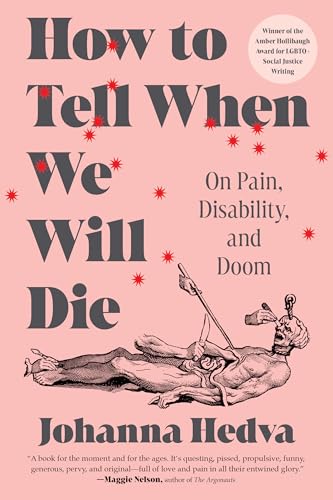
“A book for the moment and for the ages. It’s questing, pissed, propulsive, funny, generous, pervy, and original—full of love and pain in all their entwined glory.” —Maggie Nelson, author of The Argonauts
WINNER OF THE AMBER HOLLIBAUGH AWARD FOR LGBTQ+ SOCIAL JUSTICE WRITING
The long-awaited essay collection from one of the most influential voices in disability activism that detonates a bomb in our collective understanding of care and illness, showing us that sickness is a fact of life.
In the wake of the 2014 Ferguson riots, and sick with a chronic condition that rendered them housebound, Johanna Hedva turned to the page to ask: How do you throw a brick through the window of a bank if you can’t get out of bed? It was not long before this essay, “Sick Woman Theory”, became a seminal work on disability, because in reframing illness as not just a biological experience but a social one, Hedva argues that under capitalism—a system that limits our worth to the productivity of our bodies—we must reach for the revolutionary act of caring for ourselves and others.
How to Tell When We Will Die expands upon Hedva’s paradigm-shifting perspective in a series of slyly subversive and razor-sharp essays that range from the theoretical to the personal—from Deborah Levy and Susan Sontag to wrestling, kink, mysticism, death, and the color yellow. Drawing from their experiences with America’s byzantine healthcare system, and considering archetypes they call The Psychotic Woman, The Freak, and The Hag in Charge, Hedva offers a bracing indictment of the politics that exploit sickness—relying on and fueling ableism—to the detriment of us all.
With the insight of Anne Boyer’s The Undying and Leslie Jamison’s The Empathy Exams, and the wit of Samantha Irby, Hedva’s debut collection upends our collective understanding of disability. In their radical reimagining of a world where care and pain are symbiotic, and our bodies are allowed to live free and well, Hedva implores us to remember that illness is neither an inconvenience or inevitability, but an enlivening and elemental part of being alive.
WINNER OF THE AMBER HOLLIBAUGH AWARD FOR LGBTQ+ SOCIAL JUSTICE WRITING
The long-awaited essay collection from one of the most influential voices in disability activism that detonates a bomb in our collective understanding of care and illness, showing us that sickness is a fact of life.
In the wake of the 2014 Ferguson riots, and sick with a chronic condition that rendered them housebound, Johanna Hedva turned to the page to ask: How do you throw a brick through the window of a bank if you can’t get out of bed? It was not long before this essay, “Sick Woman Theory”, became a seminal work on disability, because in reframing illness as not just a biological experience but a social one, Hedva argues that under capitalism—a system that limits our worth to the productivity of our bodies—we must reach for the revolutionary act of caring for ourselves and others.
How to Tell When We Will Die expands upon Hedva’s paradigm-shifting perspective in a series of slyly subversive and razor-sharp essays that range from the theoretical to the personal—from Deborah Levy and Susan Sontag to wrestling, kink, mysticism, death, and the color yellow. Drawing from their experiences with America’s byzantine healthcare system, and considering archetypes they call The Psychotic Woman, The Freak, and The Hag in Charge, Hedva offers a bracing indictment of the politics that exploit sickness—relying on and fueling ableism—to the detriment of us all.
With the insight of Anne Boyer’s The Undying and Leslie Jamison’s The Empathy Exams, and the wit of Samantha Irby, Hedva’s debut collection upends our collective understanding of disability. In their radical reimagining of a world where care and pain are symbiotic, and our bodies are allowed to live free and well, Hedva implores us to remember that illness is neither an inconvenience or inevitability, but an enlivening and elemental part of being alive.
BUY THE BOOK
Community Reviews
Purposefully disorganized, unfortunately to it’s detriment, but still a thought-provoking collection of varyingly-well-written essays that I would suggest to a specific kind of disabled queer person and no other. This pro-violence post-Tumblrite kinky charm doesn’t land with nearly as many people as it used to, but I still have room in my own heart for it. So I got a lot of enjoyment out of this.
I didn’t love Can I Hit You?, and the essay about their mother’s death. The former was just not my cup of tea—I can appreciate it, and agree that violence has a place in the wider story of human history and the personal, but it felt like too big & abrupt of a departure from the rest of the book—and the latter was personally difficult because it was so powerfully intimate.
What I don’t like: I know it’s based on previous theory that sets up the groundwork for understanding everyone as female, even and especially if they’re averse to the idea, but as a wholly binary trans man who’s had his identity invalidated by nonbinary folks too many times before, it gave me a little stab of pain to read the “Woman” of “The Sick Woman Theory” part every time. I can see myself so well in this caricature, but the insistence on femaleness kept me outside the gates at all times. You could see this as me being a crybaby, an entitled man who’s upset things weren’t made for him, who just didn’t read the right literature beforehand. Or I’m a marginalized person who feels just a little left out in a conversation that directly included him in one single sentence, a conversation inherently connecting experiences of disability with womanhood, or at least not-manhood. I understand from a theoretical point what the author was saying, and that this is the opposite of their intentions, but it still came off as exclusive, like I’m reading a book that’s not speaking to me when it very well could’ve. And this parallels experiences I’ve had with nonbinary people who are very accepting and loving and talkative to and about trans women, trans fems, and nonbinary folks—but quietly hostile to trans men and transmascs.
That was truly my only complaint. Besides that, this is exactly the kind of writing I like to read. Is it perfect? No. But it feels like being told a long, meandering story by a strange old “woman” outside a smelly, crowded bar, and I think that image would please the author. It made me think about my own life, my own experiences of illness, transness, how I’ll feel when my mother dies. There are times when I felt the author couldn’t be less like me—especially when they’re talking about all of their “crip” friends, their lavish solo-vacation, their serious convictions about astrology—but many other times when I felt like they could be someone I know, someone from an apartment in the next building over.
I want more essay collections like this, even if they aren’t 5 star reads, even if they don’t get perfect reviews or critic scores.
I didn’t love Can I Hit You?, and the essay about their mother’s death. The former was just not my cup of tea—I can appreciate it, and agree that violence has a place in the wider story of human history and the personal, but it felt like too big & abrupt of a departure from the rest of the book—and the latter was personally difficult because it was so powerfully intimate.
What I don’t like: I know it’s based on previous theory that sets up the groundwork for understanding everyone as female, even and especially if they’re averse to the idea, but as a wholly binary trans man who’s had his identity invalidated by nonbinary folks too many times before, it gave me a little stab of pain to read the “Woman” of “The Sick Woman Theory” part every time. I can see myself so well in this caricature, but the insistence on femaleness kept me outside the gates at all times. You could see this as me being a crybaby, an entitled man who’s upset things weren’t made for him, who just didn’t read the right literature beforehand. Or I’m a marginalized person who feels just a little left out in a conversation that directly included him in one single sentence, a conversation inherently connecting experiences of disability with womanhood, or at least not-manhood. I understand from a theoretical point what the author was saying, and that this is the opposite of their intentions, but it still came off as exclusive, like I’m reading a book that’s not speaking to me when it very well could’ve. And this parallels experiences I’ve had with nonbinary people who are very accepting and loving and talkative to and about trans women, trans fems, and nonbinary folks—but quietly hostile to trans men and transmascs.
That was truly my only complaint. Besides that, this is exactly the kind of writing I like to read. Is it perfect? No. But it feels like being told a long, meandering story by a strange old “woman” outside a smelly, crowded bar, and I think that image would please the author. It made me think about my own life, my own experiences of illness, transness, how I’ll feel when my mother dies. There are times when I felt the author couldn’t be less like me—especially when they’re talking about all of their “crip” friends, their lavish solo-vacation, their serious convictions about astrology—but many other times when I felt like they could be someone I know, someone from an apartment in the next building over.
I want more essay collections like this, even if they aren’t 5 star reads, even if they don’t get perfect reviews or critic scores.

See why thousands of readers are using Bookclubs to stay connected.