The End of Everything: How Wars Descend into Annihilation
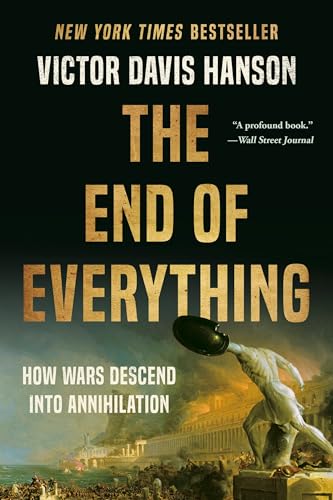
An Instant New York Times Bestseller A major military historian explains how and why some societies chose to destroy their foes, and warns that similar wars of obliteration are possible in our time. "A profound book." --Wall Street Journal War can settle disputes, topple tyrants, and bend the trajectory of civilization--sometimes to the breaking point. From Troy to Hiroshima, moments when war has ended in utter annihilation have reverberated through the centuries, signaling the end of political systems, cultures, and epochs. Though much has changed over the millennia, human nature remains the same. Modern societies are not immune from the horror of a war of extinction. In The End of Everything, military historian Victor Davis Hanson narrates a series of sieges and sackings that span the age of antiquity to the conquest of the New World to show how societies descend into barbarism and obliteration. In the stories of Thebes, Carthage, Constantinople, and Tenochtitlan, he depicts war's drama, violence, and folly. Highlighting the naivete that plagued the vanquished and the wrath that justified mass slaughter, Hanson delivers a sobering call to contemporary readers to heed the lessons of obliteration lest we blunder into catastrophe once again.
BUY THE BOOK
Community Reviews
The one thing that has always been consistent in life outside of death and taxes is human nature. It does not change. In The End of Everything, author Victor Davis Hanson discusses how mankind’s penchant for settling differences with armed conflict can ultimately end in total annihilation. Hanson, a military historian delves into four civilizations of antiquity, Thebes, Carthage, Constantinople, and Tenochtitlán, each lasting almost 1000 years or more and considered invincible by their inhabitants. All these civilizations who sang the mantra “it can’t happen here” have completely disappeared.
As the author narrates this tale of impossibility it is like looking into a mirror at what could well be our own civilization’s demise. It has been said that those who refuse to learn from history are doomed to repeat it, but what does history know? War creates a decent into destruction, barbarism, and eventually obliteration. As I read the pages of this thought-provoking book, I thought of General Douglas McArthur’s quote “I know war as few other men now living know it, and nothing to me is more revolting. I have long advocated its complete abolition, as its very destructiveness on both friend and foe has rendered it useless as a means of settling international disputes... But once war is forced upon us, there is no other alternative than to apply every available means to bring it to a swift end.”
Victor D. delivers a sobering narrative calling on us to heed the lessons taught by these societies who began with promise and ended in complete annihilation. In the stories of Thebes, Carthage, Constantinople, and Tenochtitlan, he depicts war’s drama, violence, and folly. Highlighting the naivete of the vanquished and the wrath of the victors, that justified mass slaughter. The whole narrative begs the question are we blundering into the same catastrophe?
