The El: A Novel
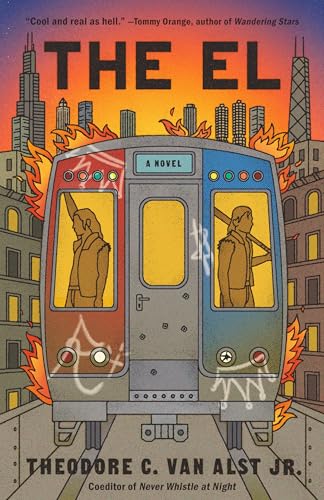
WINNER OF THE CHIRBY FICTION AWARD • From the co-editor of the bestselling anthology Never Whistle at Night, a semi-autobiographical novel that follows a group of teenage gang members as they trek across Chicago to a momentous meeting, inspired by the cult classic The Warriors
“Cool and real as hell.” —Tommy Orange, bestselling author of There There
An ordinary day in August 1979 dawns hot and humid in Chicago. Teenager Teddy is living with his dad after being kicked out of his mom’s house due to his gang activity. But Teddy has thrived in the Simon City Royals, and today, he'll be helping to lead a posse of the group's younger members south across the city to Roosevelt High School to attend a gathering of gangs forming “the Nation”—a bold new attempt at joining forces across racial lines. This holds particular importance for Teddy, as his branch’s only Indigenous member.
But when the meeting breaks up in gunshots and police sirens, Teddy must guide the Royals back across hostile territory, along secret routes and back alleys, and stop by stop on the thundering tracks of the El. In the face of violence from rival gangs and a secret Judas in the Royals’ ranks, Teddy is armed only with a potent combination of book smarts and street smarts, and by the guiding spirit of Coyote, who has granted him the power to glimpse a future only he may survive to see.
Immersed in the sights, sounds, and smells of the author’s beloved city, The El will transport you to that singular sun- and blood-soaked day in Chicago. It is a love letter to another time, to a city, and to a group of friends trying to find their place and make their way in a world that doesn’t want them.
BUY THE BOOK
Community Reviews
Those who believe leaders are born did not mature into adulthood in an urban setting.
Because cities require orderly movement of inhabitants, they are often compared to the human circulatory system; roads and rail are the arteries and veins needed to move people, the lifeblood, to and from.
Set in 1979 among Chicago’s infamous train cars, The El is a semi-autobiographical account of life in America’s most segregated city. It features Teddy, the spiritually superstitious de facto leader of a street gang sect, and it moves as quickly as an engine whipping around concave curves.
Short in stature, an avid reader, and a weed smoker, Teddy is the product of a broken home. Although he lives with a father who is responsible enough to meet Maslow’s minimum, defining the same man as accountable to anyone not featured on a liquor label is a stretch.
The eldest of three, he is a bit of a looker, but his mother’s cold nature has Teddy convinced that women are not yet worth the effort. Studious enough to willingly return to school after dropping out, he is often mistaken for an immigrant despite being an Indigenous American and native to the city.
A deep thinker struggling with being placed in the seat of authority, he is further troubled by being tasked with safely escorting the mixed-race group into and through rival gang territory to a mandatory city-wide unification summit.
Filled with vivid descriptions of Chicago’s collection of neighborhoods, its commentary on the paradox of being one of the most diverse, yet racially segregated, is spot on. Gritty, immersive, and accurate, astute readers will not miss the symbolic representations of how minorities are affected by the rate, rhythm, and modulation of seemingly disconnected urban journeys.
Authentic in its representation of how everyone, especially those with starched collars, is, by default, gang-affiliated, this work challenges readers to reconsider the constraints and systemic factors that influence choice and identity. Because of its realistic portrayal of urbanized Indigenous Americans, readers should not expect a narrative filled with historical context or syllogisms about life on the plains.
This work explores the need to form conventional sub-communities to navigate invisible and visible threats. It blends dialogue and action with introspective snatches into opposing views on institutionalized challenges resulting from socialized neglect to provide glimpses into discriminatory poverty.
Written by Theodore C. Van Alst, Jr., an enrolled member of the Mackinac Bands of Chippewa and Ottawa Indians, it’s a refreshingly overdue portrayal of strength in diversity. If the reality of culture shock is allegedly limited to immigrants, readers are cautioned to consider that Indigenous Americans were present when Columbus landed.
Because cities require orderly movement of inhabitants, they are often compared to the human circulatory system; roads and rail are the arteries and veins needed to move people, the lifeblood, to and from.
Set in 1979 among Chicago’s infamous train cars, The El is a semi-autobiographical account of life in America’s most segregated city. It features Teddy, the spiritually superstitious de facto leader of a street gang sect, and it moves as quickly as an engine whipping around concave curves.
Short in stature, an avid reader, and a weed smoker, Teddy is the product of a broken home. Although he lives with a father who is responsible enough to meet Maslow’s minimum, defining the same man as accountable to anyone not featured on a liquor label is a stretch.
The eldest of three, he is a bit of a looker, but his mother’s cold nature has Teddy convinced that women are not yet worth the effort. Studious enough to willingly return to school after dropping out, he is often mistaken for an immigrant despite being an Indigenous American and native to the city.
A deep thinker struggling with being placed in the seat of authority, he is further troubled by being tasked with safely escorting the mixed-race group into and through rival gang territory to a mandatory city-wide unification summit.
Filled with vivid descriptions of Chicago’s collection of neighborhoods, its commentary on the paradox of being one of the most diverse, yet racially segregated, is spot on. Gritty, immersive, and accurate, astute readers will not miss the symbolic representations of how minorities are affected by the rate, rhythm, and modulation of seemingly disconnected urban journeys.
Authentic in its representation of how everyone, especially those with starched collars, is, by default, gang-affiliated, this work challenges readers to reconsider the constraints and systemic factors that influence choice and identity. Because of its realistic portrayal of urbanized Indigenous Americans, readers should not expect a narrative filled with historical context or syllogisms about life on the plains.
This work explores the need to form conventional sub-communities to navigate invisible and visible threats. It blends dialogue and action with introspective snatches into opposing views on institutionalized challenges resulting from socialized neglect to provide glimpses into discriminatory poverty.
Written by Theodore C. Van Alst, Jr., an enrolled member of the Mackinac Bands of Chippewa and Ottawa Indians, it’s a refreshingly overdue portrayal of strength in diversity. If the reality of culture shock is allegedly limited to immigrants, readers are cautioned to consider that Indigenous Americans were present when Columbus landed.

See why thousands of readers are using Bookclubs to stay connected.