Race After Technology: Abolitionist Tools for the New Jim Code
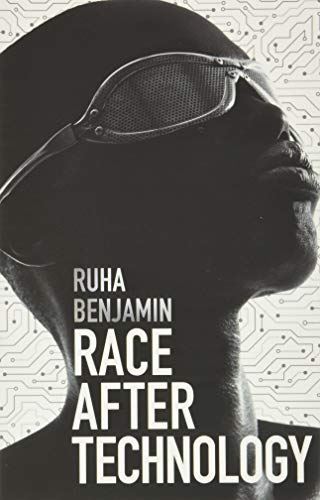
From everyday apps to complex algorithms, Ruha Benjamin cuts through tech-industry hype to understand how emerging technologies can reinforce White supremacy and deepen social inequity.
Benjamin argues that automation, far from being a sinister story of racist programmers scheming on the dark web, has the potential to hide, speed up, and deepen discrimination while appearing neutral and even benevolent when compared to the racism of a previous era. Presenting the concept of the "New Jim Code," she shows how a range of discriminatory designs encode inequity by explicitly amplifying racial hierarchies; by ignoring but thereby replicating social divisions; or by aiming to fix racial bias but ultimately doing quite the opposite. Moreover, she makes a compelling case for race itself as a kind of technology, designed to stratify and sanctify social injustice in the architecture of everyday life.
This illuminating guide provides conceptual tools for decoding tech promises with sociologically informed skepticism. In doing so, it challenges us to question not only the technologies we are sold but also the ones we ourselves manufacture.
Visit the book's free Discussion Guide: dropbox.com
BUY THE BOOK
Community Reviews
The most valuable thing about this book is probably just that it’s examining an area which has been relatively unexplored. It’s looking at the intersection of race & technology—fertile ground for exploration, especially as so many modern tech developers and promoters constantly claim that tech is neutral, race-blind, etc. But as Kranzberg’s First Law tells us: “Technology is neither good nor bad; nor is it neutral.” It’s critical to question the “unbiased” ethos of tech, and this book is an attempt to do that. See a couple of her sources, though—Algorithms of Oppression or Weapons of Math Destruction—for stronger work in the same area.
Benjamin’s most compelling insight is on what she calls “technological benevolence”—technology that’s (supposedly, or even genuinely) intended to correct or mitigate social harms, and instead reproduces or deepens them. “The road to inequity is paved with technical fixes.” True enough; we are often far too accepting of both technological opacity and developers’ claims of benevolence. Emerging tech is often uncritically adopted, and its negative outcomes can remain obscure. In the end, it comes back to the common refrain: racism is not about intent, it’s about impact.
My frustration with the book, really, is that I never developed any confidence in Benjamin’s own scholarship. She cites a multitude of sources, and the book feels academic, but she also takes some real leaps. She spends time responding to unfounded suppositions, a comment overheard in an airport restaurant, coincidental linguistic connections, etc. These kinds of shortcuts rarely yield surprising insights, though, much less ever seriously challenge our priors. And they undermine my trust when the book does go somewhere unexpected. I want to see an author struggling with the complexity of an issue, and challenging me to do so, rather than conclusions that seem to precede the evidence.

See why thousands of readers are using Bookclubs to stay connected.