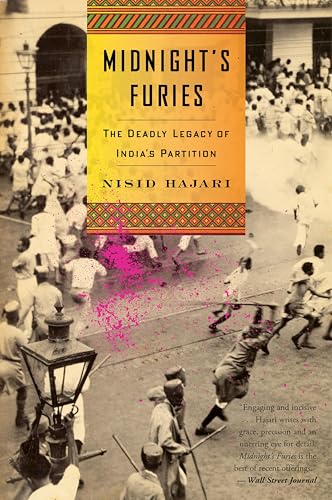
Midnight's Furies: The Deadly Legacy of India's Partition
An NPR Book of the Year
A Seattle Times Book of the Year
William E. Colby Award Winner
“A beautifully written, deeply intelligent book about [a] crucial moment.” — Fareed Zakaria, CNN
Nobody expected the liberation of India and birth of Pakistan to be so violent—it was supposed to be an answer to the dreams of Muslims and Hindus who had been ruled by the British for more than a century. But as the summer of 1947 approached, Muslims, Hindus, and Sikhs were heavily armed and on edge after a year of riots and gang fighting, and the British rushed to leave. Hell broke loose. Trains carried Muslims west and Hindus east to their slaughter. Some of the most brutal and widespread ethnic cleansing in modern history erupted on both sides of the new border, searing a divide between India and Pakistan that remains a root cause of many of today’s most menacing security threats, from jihadi terrorism to nuclear proliferation. Based on major new sources, Nisid Hajari’s revelatory Midnight’s Furies lays out the searing truth about one of the world’s most momentous and least understood tragedies.
“Fast-moving and highly readable . . . The story of what happens when a composite society comes apart.” — New York Times Book Review
“Makes the complex and tragic story of the great divide into a page-turner.” — Guardian
“Engaging and incisive . . . Hajari writes with grace, precision, and an unerring eye for detail. Midnight’s Furies is the best of recent offerings.” — Wall Street Journal
BUY THE BOOK
Community Reviews
This book absolutely brings the violence and desolation of the Partition struggle to life. What it doesn’t do, at least for me, is provide a coherent explanation of what caused and sustained that violence. Certainly there were religious & cultural tensions on the ground. And the book extensively details the inter-personal antipathy between Jinnah & Nehru. But for that elite-level conflict to have manifested at the level that it did, there must have been an important and interesting intermediate layer of political organization/leadership connecting these Great Men to the masses who actually bore the conflict. Unfortunately, Hajari does not spend much time in that space.
At the two levels where it does operate, though, it’s a strong book. At the popular level, you get a real sense of the nature and scale of the massacres and retaliations taking place. Hajari fully details the growth of intolerance, mistrust and fear among the subcontinent’s Hindu, Muslim, and Sikh populations. One valuable insight from the book—expressed clearly at one point by a British ambassador, of all people—is the way masses of people act on their own expectations of what the other side might do, at least as much as on verifiable evidence of what’s been done. This book’s depiction of the Partition conflict provides a prime example of how that particular kind of hostility lends itself to cycles of violence, pretty far beyond anyone’s control.
Then too, we’re given quite full portrayals of Jinnah and Nehru, undoubtedly the two most important individuals in this historical moment. From this book alone, one could certainly make a case that the nature of Partition was little more than a manifestation of their inter-personal conflict. Is that accurate? I’m not inclined to believe so, but I also don’t know nearly enough about the history of the area to say otherwise.
So I do feel much more aware of the nature and details of the Partition conflict, but at the same time I’m still left with some fundamental questions. Would this conflict have taken place without the influence of Nehru or Jinnah? Were there political and social structures in place that would inevitably have cleaved India’s Muslim populations away from the newly independent state? If not, would these same sorts of conflagrations have taken place within the nascent state? Would it have survived? I know these kinds of questions are never truly answerable, but to even begin to consider them, I think I would need a much fuller sense of how Jinnah & Nehru’s influence actually traveled from the top down through Indian society. This book doesn’t get me there.

See why thousands of readers are using Bookclubs to stay connected.