Light in August
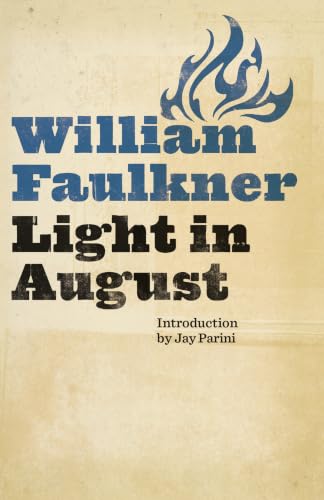
From the Nobel Prize winner—one of the most highly acclaimed writers of the twentieth century—a novel set in the American South during Prohibition about hopeful perseverance in the face of mortality.
Light in August features some of Faulkner’s most memorable characters: guileless, dauntless Lena Grove, in search of the father of her unborn child; Reverend Gail Hightower, who is plagued by visions of Confederate horsemen; and Joe Christmas, a desperate, enigmatic drifter consumed by his mixed ancestry.
“Read, read, read. Read everything—trash, classics, good and bad, and see how they do it. Just like a carpenter who works as an apprentice and studies the master. Read! You’ll absorb it. Then write. If it is good, you’ll find out. If it’s not, throw it out the window.” —William Faulkner
BUY THE BOOK
Community Reviews
This was my 6th Faulkner (As I Lay Dying, The Sound and the Fury, Sanctuary, Absalom Absalom, The Unvanquished). That doesn't count several short stories.
I had read that Light in August is his most accessible work. That is not true. It is the most accessible of his experimental work. His short stories are far more accessible. They tend to be very straight forward by comparison in that they are often not in his stream of consciousness mode. They might use different perspectives, but you usually have an objective narrator that smooths things out a bit. This was also true of The Unvanquished, which is really just several connected short stories.
Having got that out of the way, Light in August was good. I liked to story it told. And there were many passages in it that were as beautiful as anything else Faulkner has written. However, I did encounter a number of spots where the stream of conscious narrative style coincided with poetic diction and syntax that unfortunately left things quite unclear. Usually, when you run into this sort of thing, it's just a matter of reading on and then retrospectively decoding the ambiguous passage. But there were several times where that didn't really work. I think this was because of the large variety of narrators, many of whom had their own backstories. Because he jumped around more, he didn't end up retreading ground quite as much as he normally does. Normally, I would say great, because for all his poetry, I do not appreciate when narratives get repetitive. But in this case, the repetition would have helped with ambiguity.
Any way, it wasn't fatal to the novel. But it was annoying.
Of the parts I did like, I take it to be that all these stories are focused on outcasts and outsiders. They deal with loneliness, social ostracism, and how different characters cope with that. One is biracial and extremely tortured by that fact, given that while he could pass for white, he had 'one drop' of 'black blood' and thus, once that became common knowledge, he instantly became black in everyone's eyes, and was treated accordingly. Another is an unwed teenage mother who turns out to be modeled on Leda and the Swan and who seems to be quixotic and naive but turns out to be the most mentally stable and resourceful of them all. Another is a pastor who abuses his pulpit for his own purposes (really weird sermons about his grandfather, repeated over and over) and gets exiled, but who turns out to be the moral center of the book with the only properly authentic understanding of christian ethics for several hundred miles. There are others.
These are all good stories - I'm just not sure that the modernist aspect, specifically the stream of consciousness and really not even that but the vague moments within that stream, helped the story at all - certainly not in the way that it was pulled off in Sound and Fury or Absalom.
I had read that Light in August is his most accessible work. That is not true. It is the most accessible of his experimental work. His short stories are far more accessible. They tend to be very straight forward by comparison in that they are often not in his stream of consciousness mode. They might use different perspectives, but you usually have an objective narrator that smooths things out a bit. This was also true of The Unvanquished, which is really just several connected short stories.
Having got that out of the way, Light in August was good. I liked to story it told. And there were many passages in it that were as beautiful as anything else Faulkner has written. However, I did encounter a number of spots where the stream of conscious narrative style coincided with poetic diction and syntax that unfortunately left things quite unclear. Usually, when you run into this sort of thing, it's just a matter of reading on and then retrospectively decoding the ambiguous passage. But there were several times where that didn't really work. I think this was because of the large variety of narrators, many of whom had their own backstories. Because he jumped around more, he didn't end up retreading ground quite as much as he normally does. Normally, I would say great, because for all his poetry, I do not appreciate when narratives get repetitive. But in this case, the repetition would have helped with ambiguity.
Any way, it wasn't fatal to the novel. But it was annoying.
Of the parts I did like, I take it to be that all these stories are focused on outcasts and outsiders. They deal with loneliness, social ostracism, and how different characters cope with that. One is biracial and extremely tortured by that fact, given that while he could pass for white, he had 'one drop' of 'black blood' and thus, once that became common knowledge, he instantly became black in everyone's eyes, and was treated accordingly. Another is an unwed teenage mother who turns out to be modeled on Leda and the Swan and who seems to be quixotic and naive but turns out to be the most mentally stable and resourceful of them all. Another is a pastor who abuses his pulpit for his own purposes (really weird sermons about his grandfather, repeated over and over) and gets exiled, but who turns out to be the moral center of the book with the only properly authentic understanding of christian ethics for several hundred miles. There are others.
These are all good stories - I'm just not sure that the modernist aspect, specifically the stream of consciousness and really not even that but the vague moments within that stream, helped the story at all - certainly not in the way that it was pulled off in Sound and Fury or Absalom.

See why thousands of readers are using Bookclubs to stay connected.