Chicks Rule!: A Picture Book
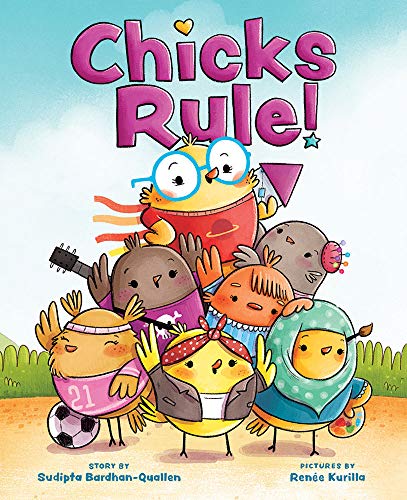
A celebration of girl power and community action, author Sudipta Bardhan-Quallen and illustrator Renée Kurilla's picture book Chicks Rule! is the playful, diverse, victorious anthem chicks everywhere will love. All in step with wing in wing . . . Chicks can conquer anything! Nerdy Chick has been waiting all day for the Rocket Club meeting. But when she gets there, she finds a disturbing sign tacked to the door: "NO CHICKS ALLOWED!!!" Puzzled, then baffled, then just plain mad, Nerdy Chick sets out to change the rules. Along the way, she meets other chicks who are just like her: passionate and determined. From Soccer Chick to Science Chick and Wordy Chick to Yoga Chick, these chicks aren't willing to take "NO" for an answer. They rally together, march to the barn at the center of town, and--when they hear "NO" once again--chart their own path forward (or, rather, up, up, and away!). "A fun and lively read-aloud about empowering girls, and a splendid example of what a community can accomplish when everyone is included." --School Library Journal Also available:
Chicks Rock!
BUY THE BOOK
Community Reviews
I'm not a fan of any race or gender divide in children's books that is aimed at making some group look bad or mean. It's okay for moral philosophy books but here it feels very destructive without really presenting a good point. Especially because the book gets some history wrong too that wrongly accuses men or being sexist in some job settings. That didn't happen in real life but is here used as the main story setting for some reason.
It's a modern feminist book but it's not a good one. It's a copy of Dr. Suess's style but the end rhyme is often just rhyming "chicks" with "chicks". So it comes out as being lazy while also being a bad imitation of a superior style. It doesn't really find its own legs.
I really don't recommend this for kids. It can sow a seed of hate and dislike towards the outgroup as it is mispresented here. I don't think making a real group seem like sufferers or another group seem like having unfair power is a good idea for such books unless it's 100% historically accurate. There is a way to tell the same moral tale without using genders or real-life settings if one wants to just make up a creative story and setting anyhow. But at the end of the day, it just makes for a terrible story that doesn't speak to critical readers. And that cannot really be fixed by any simple theme or setting change.
It's a modern feminist book but it's not a good one. It's a copy of Dr. Suess's style but the end rhyme is often just rhyming "chicks" with "chicks". So it comes out as being lazy while also being a bad imitation of a superior style. It doesn't really find its own legs.
I really don't recommend this for kids. It can sow a seed of hate and dislike towards the outgroup as it is mispresented here. I don't think making a real group seem like sufferers or another group seem like having unfair power is a good idea for such books unless it's 100% historically accurate. There is a way to tell the same moral tale without using genders or real-life settings if one wants to just make up a creative story and setting anyhow. But at the end of the day, it just makes for a terrible story that doesn't speak to critical readers. And that cannot really be fixed by any simple theme or setting change.

See why thousands of readers are using Bookclubs to stay connected.