A Troublesome Inheritance: Genes, Race and Human History
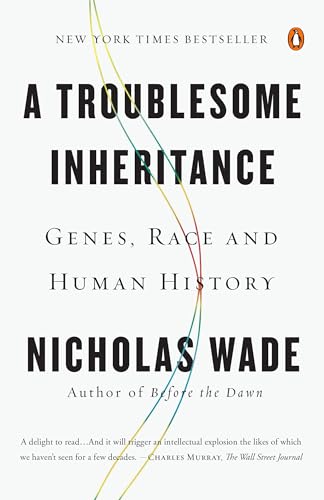
Drawing on startling new evidence from the mapping of the genome, an explosive new account of the genetic basis of race and its role in the human story
Fewer ideas have been more toxic or harmful than the idea of the biological reality of race, and with it the idea that humans of different races are biologically different from one another. For this understandable reason, the idea has been banished from polite academic conversation. Arguing that race is more than just a social construct can get a scholar run out of town, or at least off campus, on a rail. Human evolution, the consensus view insists, ended in prehistory.
Inconveniently, as Nicholas Wade argues in A Troublesome Inheritance, the consensus view cannot be right. And in fact, we know that populations have changed in the past few thousand years—to be lactose tolerant, for example, and to survive at high altitudes. Race is not a bright-line distinction; by definition it means that the more human populations are kept apart, the more they evolve their own distinct traits under the selective pressure known as Darwinian evolution. For many thousands of years, most human populations stayed where they were and grew distinct, not just in outward appearance but in deeper senses as well.
Wade, the longtime journalist covering genetic advances for The New York Times, draws widely on the work of scientists who have made crucial breakthroughs in establishing the reality of recent human evolution. The most provocative claims in this book involve the genetic basis of human social habits. What we might call middle-class social traits—thrift, docility, nonviolence—have been slowly but surely inculcated genetically within agrarian societies, Wade argues. These “values” obviously had a strong cultural component, but Wade points to evidence that agrarian societies evolved away from hunter-gatherer societies in some crucial respects. Also controversial are his findings regarding the genetic basis of traits we associate with intelligence, such as literacy and numeracy, in certain ethnic populations, including the Chinese and Ashkenazi Jews.
Wade believes deeply in the fundamental equality of all human peoples. He also believes that science is best served by pursuing the truth without fear, and if his mission to arrive at a coherent summa of what the new genetic science does and does not tell us about race and human history leads straight into a minefield, then so be it. This will not be the last word on the subject, but it will begin a powerful and overdue conversation.
BUY THE BOOK
Community Reviews
1 Evolution, Race and History 1
8/10
A bit weird start. He mentions a few interesting findings on race, but then doesn't go into them, instead he says he will explain them in later chapters. It's an overview of the topic of race in the book and this chapter has a few interesting historical facts too.
2 Perversions of Science 16
6/10
Unfortunately he does some "journalist" research that we know from MSM and NYT where a causality conclusion is reached based on very flimsy evidence randomly put together. This is why so many intellectuals criticise NYT. In this chapter Wade concludes that Galton's loose ideas must basically have caused Hitler to kill Jews. Other great thinkers are also blamed for everything Hitler did. He just draws a straight line from 19th century ideas in British scientific litterature to Hitler without giving us any evidence for the causality. Without Galton no KZ camps? Personally I'm not convinced as there is no clear evidence for any of this. Eugenics as a concept is also not what Hitler did to Jews for example. Nazis knew Jews scored higher on IQ tests which is why they largely abolished using them while Americans, who focused on IQ, soon had to admit that Jews had high IQ and were actually worth a lot to the overall economy and research in the country. The IQ test based on Galton's ideas was an advancement for Jewish safety in the countries that actually implemented Galton's ideas. Hitler's Jew hate, very common to most Christian and Muslim countries back then, was an antithesis to eugenics. It's pure hate and has nothing to do with deselecting actual bad genes as we knew Jews had BETTER not worse genes which is why scientific blindness was required in socialist countries when it came to mass killings. A hypothetical top-down eugenics based ideology would only cause Hitler to select advantageous traits and deselecting disadvantageous traits. That wouldn't even require any mass killing to be effective on a societal scale, you just need to fine people for not following the rules.
If you want to claim that Hitler would just be some regular war leader if Galton didn't exist you need to make some case for it. Wade, in this chapter, doesn't give us even a single shred of evidence that Hitler even knew about Galton or eugenics. And even worse for Wade's argument, the ideology that Hitler actually used, social darwinism, is an antithesis to all what Darwin said about evolution. Group selection itself, used by USSR and National Socialists, is a pseudoscience. Eugenics thinking is based on Darwin's theory of natural selection while social darwinism is based on ideological socialist doctrines created for mass extermination of "bad" thinkers. Darwin wasn't a socialist. Galton wasn't a socialist. So where is the connection here?
3 Origins of Human Social Nature 39
7/10
It's still not a strong book. He mentions a ton of good science, but then also focuses a lot of vague social science like smaller studies on oxytocin and the MAO-A gene. These are good studies for sure, but still not conclusive findings and not conclusively proven theories. Single gene or single hormone ideas are usually weak and hard to replicate because it's not really how the advanced human body works in 99% of cases. But I understand why a writer for laymen would want to use the most simple example of a gene to phenotype effect.
I like his explanation of group behavior overall, but it's still not focused writing.
4 The Human Experiment 67
9/10
Could have been better sourced in the text itself but this is surely THE very best intro to races we have? I certainly have never read anything this specific, simple, concrete and direct on the topic of race. Finally something even uninformed laymen will easily understand. There are 3 main race groups and a few subrace groups too.
I can't get over how direct this chapter was compared to most academic bullshit writing we have on race where the writers are afraid of saying anything at all. Here the directness is a good thing, but it's a bad thing when Wade unwillingly wanders into new studies that are not yet conclusive theories.
5 The Genetics of Race 95
7/10
There is a ton of fascinating info here for sure. Hard sweeps vs. soft sweeps is one of the very best intros to modern genetics I've ever read and it completely dispels the notion that if we haven't found a single big gene to prove a race difference then the race difference doesn't exist.
Yet all this DNA info overall is not ideal for me as I have the worst memory ever. It's a lot of details and names about how genetics works. It's technical and mostly focuses on names for things as all this DNA stuff tends to do.
We get to understand why races exist. But it's also where the book shows what it's lacking. It lacks a more coherent storytelling and a more exciting presentation. It tends to just get into the technical details and lose the overview. And while it's not boring it never really gets fascinating as he never gives us any anecdotes or personal experiences. It's all just research without names. That's fine but you do need to add in a few funny stories here and there. What's the point of races if we can't experience the differences? Unfortunately I'll have to reread this book as the arguments are written in a language that's not fully accessible on audiobook format.
6 Societies and Institutions 123
8/10
This is still a bit hard to get into, but the idea itself makes this chapter. Here Wade just right away jumps into a theory that is endlessly fascinating and frankly more interesting than any philosophy I've read all year. Societies/nations have worked a certain way for hundreds of years and it has caused a certain trait selection in people so that tribes in Africa may be phenotypically adapted to live in tribe societies while China is more adapted for top-down socialist leadership. It's society influencing gene selection which is not really something we know much about, but this is very fascinating. Obviously the simple example is always just IQ differences, but smaller trait effects Wade talks about exist too. We know at least from OCEAN traits that they differ between societies in small predictable ways.
Strong chapter but he does play in the outskirts of social science. It feels like it would be easier and more factual to just mention heritability of IQ first and foremost and then explore the reasons behind it and smaller traits. But I'm writing this specific part after I read the next chapter and can say that it actually makes a ton of sense once you read more about his reasoning. I think he's just very careful in how he presents his points. Fear of backlash? Maybe, who knows?
7 The Recasting of Human Nature 150
10/10
This is great! In the other chapters Wade often just talked about theoretical concepts and hinted at scientific research. So you couldn't really judge all his claims as you weren't presented enough evidence to critically look into the claims. Here he finally presents real life data on ethnic groups. For example, Japanese and Chinese people are doing extremely well in other countries. He explains why Africa is still poor and why South Korea got rich fast or why Orientals get rich in Western countries. It's all really great as it's essential info for any social scientist. I'd argue that this chapter alone makes this book a must-read in social science. It's so well-explained that I frankly have a hard time remembering any psychology textbook or intro text explaining it even 10% as well. So no matter what area of social science you are from this is essential info. You MUST understand these arguments no matter who you are and you MUST understand them fully and correctly otherwise you'll never understand basic social science. It's that simple.
8 Jewish Adaptations 198
8/10
Strong chapter intro on Jewish intelligence, but still feels like it kinda jumps from fact to fact and largely follows new hypotheses without focusing on the known facts. It's hard to understand many of his conclusions and ideas because he just jumps into any fact or book summary he feels like, but it's still A TON of evidence and data for readers to ponder about. While it's not an easy intro, none of the chapters are, it's a great one. This is for me already a book that is must-read for any social science students and I'll make sure to recommend it a lot. But it could have been more simple for sure.
9 The Rise of the West 215
7,5/10
Here Wade expands on his theory of some races being selected to be ruled top-down by big men. And this is why these societies don't develop as well as Western countries. This again is an overall idea that has concrete proof in IQ alone, while Wade feels the need to tackle bigger and more flimsy philosophy.
Do the Chinese actually have a lower level of "group creativity" as Wade claims? Probably in some way, but before we can prove it's mostly heritable we do need to study it, describe it, define it, measure it and conclude how it works. We are just not quite there, unfortunately. It's still interesting to read about, but it's not really a hypothesis that right now has any considerable legs - besides the IQ research. Basically, China is less "creative". But we don't really know what this effect is yet.
10 Evolutionary Perspectives on Race 239
7/10
A summary of the other chapters, but since all his main points are repeated several times over in the book it's not really the most essential chapter of the book. He predicts that China may outcompete USA/the West which seems likely and is a curious idea for sure. And ideas like that, in all chapters, show that the whole book must be read.
8/10
A bit weird start. He mentions a few interesting findings on race, but then doesn't go into them, instead he says he will explain them in later chapters. It's an overview of the topic of race in the book and this chapter has a few interesting historical facts too.
2 Perversions of Science 16
6/10
Unfortunately he does some "journalist" research that we know from MSM and NYT where a causality conclusion is reached based on very flimsy evidence randomly put together. This is why so many intellectuals criticise NYT. In this chapter Wade concludes that Galton's loose ideas must basically have caused Hitler to kill Jews. Other great thinkers are also blamed for everything Hitler did. He just draws a straight line from 19th century ideas in British scientific litterature to Hitler without giving us any evidence for the causality. Without Galton no KZ camps? Personally I'm not convinced as there is no clear evidence for any of this. Eugenics as a concept is also not what Hitler did to Jews for example. Nazis knew Jews scored higher on IQ tests which is why they largely abolished using them while Americans, who focused on IQ, soon had to admit that Jews had high IQ and were actually worth a lot to the overall economy and research in the country. The IQ test based on Galton's ideas was an advancement for Jewish safety in the countries that actually implemented Galton's ideas. Hitler's Jew hate, very common to most Christian and Muslim countries back then, was an antithesis to eugenics. It's pure hate and has nothing to do with deselecting actual bad genes as we knew Jews had BETTER not worse genes which is why scientific blindness was required in socialist countries when it came to mass killings. A hypothetical top-down eugenics based ideology would only cause Hitler to select advantageous traits and deselecting disadvantageous traits. That wouldn't even require any mass killing to be effective on a societal scale, you just need to fine people for not following the rules.
If you want to claim that Hitler would just be some regular war leader if Galton didn't exist you need to make some case for it. Wade, in this chapter, doesn't give us even a single shred of evidence that Hitler even knew about Galton or eugenics. And even worse for Wade's argument, the ideology that Hitler actually used, social darwinism, is an antithesis to all what Darwin said about evolution. Group selection itself, used by USSR and National Socialists, is a pseudoscience. Eugenics thinking is based on Darwin's theory of natural selection while social darwinism is based on ideological socialist doctrines created for mass extermination of "bad" thinkers. Darwin wasn't a socialist. Galton wasn't a socialist. So where is the connection here?
3 Origins of Human Social Nature 39
7/10
It's still not a strong book. He mentions a ton of good science, but then also focuses a lot of vague social science like smaller studies on oxytocin and the MAO-A gene. These are good studies for sure, but still not conclusive findings and not conclusively proven theories. Single gene or single hormone ideas are usually weak and hard to replicate because it's not really how the advanced human body works in 99% of cases. But I understand why a writer for laymen would want to use the most simple example of a gene to phenotype effect.
I like his explanation of group behavior overall, but it's still not focused writing.
4 The Human Experiment 67
9/10
Could have been better sourced in the text itself but this is surely THE very best intro to races we have? I certainly have never read anything this specific, simple, concrete and direct on the topic of race. Finally something even uninformed laymen will easily understand. There are 3 main race groups and a few subrace groups too.
I can't get over how direct this chapter was compared to most academic bullshit writing we have on race where the writers are afraid of saying anything at all. Here the directness is a good thing, but it's a bad thing when Wade unwillingly wanders into new studies that are not yet conclusive theories.
5 The Genetics of Race 95
7/10
There is a ton of fascinating info here for sure. Hard sweeps vs. soft sweeps is one of the very best intros to modern genetics I've ever read and it completely dispels the notion that if we haven't found a single big gene to prove a race difference then the race difference doesn't exist.
Yet all this DNA info overall is not ideal for me as I have the worst memory ever. It's a lot of details and names about how genetics works. It's technical and mostly focuses on names for things as all this DNA stuff tends to do.
We get to understand why races exist. But it's also where the book shows what it's lacking. It lacks a more coherent storytelling and a more exciting presentation. It tends to just get into the technical details and lose the overview. And while it's not boring it never really gets fascinating as he never gives us any anecdotes or personal experiences. It's all just research without names. That's fine but you do need to add in a few funny stories here and there. What's the point of races if we can't experience the differences? Unfortunately I'll have to reread this book as the arguments are written in a language that's not fully accessible on audiobook format.
6 Societies and Institutions 123
8/10
This is still a bit hard to get into, but the idea itself makes this chapter. Here Wade just right away jumps into a theory that is endlessly fascinating and frankly more interesting than any philosophy I've read all year. Societies/nations have worked a certain way for hundreds of years and it has caused a certain trait selection in people so that tribes in Africa may be phenotypically adapted to live in tribe societies while China is more adapted for top-down socialist leadership. It's society influencing gene selection which is not really something we know much about, but this is very fascinating. Obviously the simple example is always just IQ differences, but smaller trait effects Wade talks about exist too. We know at least from OCEAN traits that they differ between societies in small predictable ways.
Strong chapter but he does play in the outskirts of social science. It feels like it would be easier and more factual to just mention heritability of IQ first and foremost and then explore the reasons behind it and smaller traits. But I'm writing this specific part after I read the next chapter and can say that it actually makes a ton of sense once you read more about his reasoning. I think he's just very careful in how he presents his points. Fear of backlash? Maybe, who knows?
7 The Recasting of Human Nature 150
10/10
This is great! In the other chapters Wade often just talked about theoretical concepts and hinted at scientific research. So you couldn't really judge all his claims as you weren't presented enough evidence to critically look into the claims. Here he finally presents real life data on ethnic groups. For example, Japanese and Chinese people are doing extremely well in other countries. He explains why Africa is still poor and why South Korea got rich fast or why Orientals get rich in Western countries. It's all really great as it's essential info for any social scientist. I'd argue that this chapter alone makes this book a must-read in social science. It's so well-explained that I frankly have a hard time remembering any psychology textbook or intro text explaining it even 10% as well. So no matter what area of social science you are from this is essential info. You MUST understand these arguments no matter who you are and you MUST understand them fully and correctly otherwise you'll never understand basic social science. It's that simple.
8 Jewish Adaptations 198
8/10
Strong chapter intro on Jewish intelligence, but still feels like it kinda jumps from fact to fact and largely follows new hypotheses without focusing on the known facts. It's hard to understand many of his conclusions and ideas because he just jumps into any fact or book summary he feels like, but it's still A TON of evidence and data for readers to ponder about. While it's not an easy intro, none of the chapters are, it's a great one. This is for me already a book that is must-read for any social science students and I'll make sure to recommend it a lot. But it could have been more simple for sure.
9 The Rise of the West 215
7,5/10
Here Wade expands on his theory of some races being selected to be ruled top-down by big men. And this is why these societies don't develop as well as Western countries. This again is an overall idea that has concrete proof in IQ alone, while Wade feels the need to tackle bigger and more flimsy philosophy.
Do the Chinese actually have a lower level of "group creativity" as Wade claims? Probably in some way, but before we can prove it's mostly heritable we do need to study it, describe it, define it, measure it and conclude how it works. We are just not quite there, unfortunately. It's still interesting to read about, but it's not really a hypothesis that right now has any considerable legs - besides the IQ research. Basically, China is less "creative". But we don't really know what this effect is yet.
10 Evolutionary Perspectives on Race 239
7/10
A summary of the other chapters, but since all his main points are repeated several times over in the book it's not really the most essential chapter of the book. He predicts that China may outcompete USA/the West which seems likely and is a curious idea for sure. And ideas like that, in all chapters, show that the whole book must be read.

See why thousands of readers are using Bookclubs to stay connected.